

RAILWAY BLUE PLAQUES: ILLUSTRATING 200 YEARS OF THE RAILWAYS
To celebrate two centuries of passenger railways accidental historian Danny Coope of Street of Blue Plaques has been commissioned by Southeast Communities Rail Partnership to create 200 plaques across ten South East lines for RAILWAY200’s nationwide events.
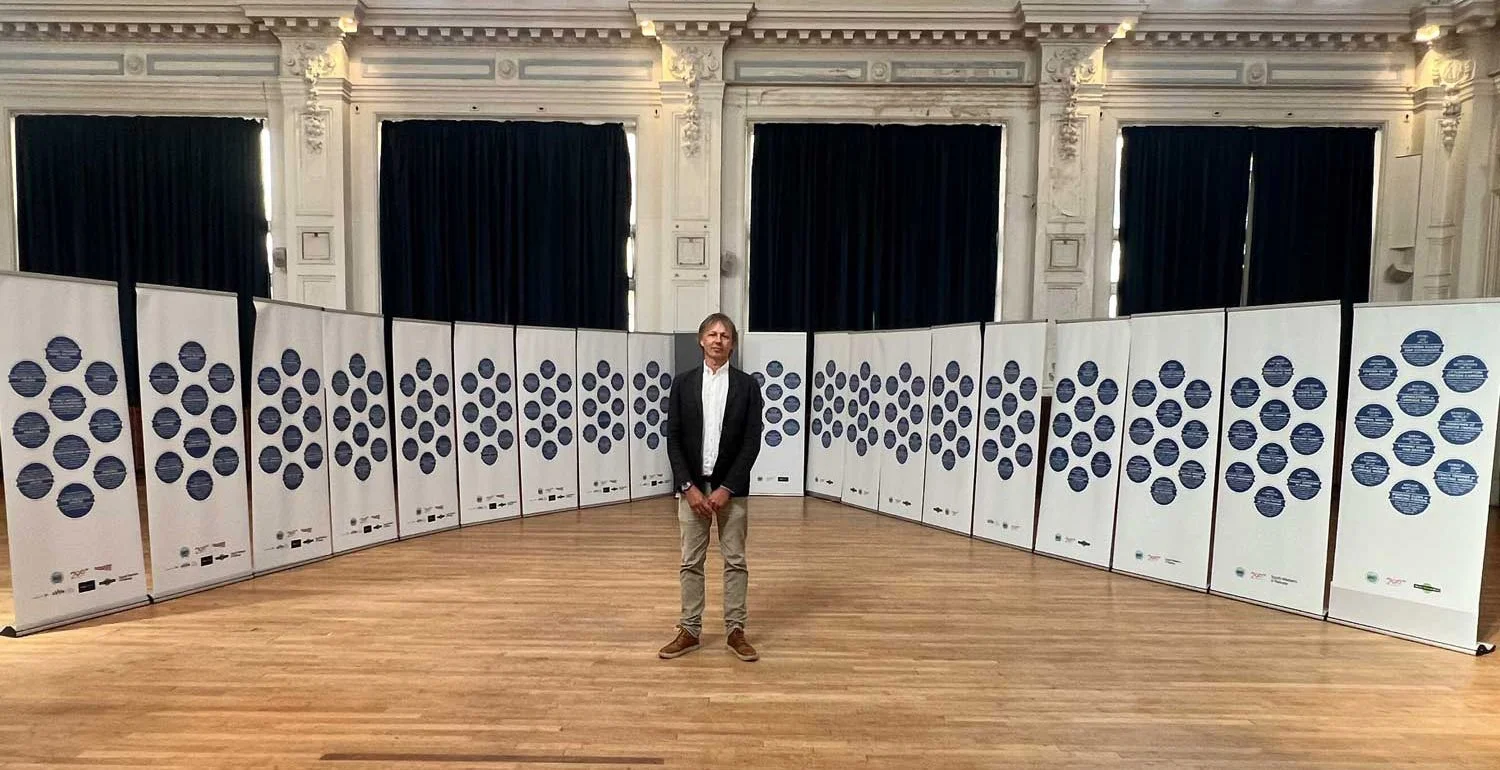
DANNY’S RAILWAY200 BLUE PLAQUES ON DISPLAY AT LEWES TOWN HALL, 1 AUGUST 2025
A really broad spectrum of people are being remembered, through whose lives and occupations we’re able to illustrate 200 years of railway history: People who’ve either made a contribution to the building of the railways, the running of the railways, making use of the railways or having their life influenced or enhanced by the railways. There are 100 historical plaques with fascinating backstories, mostly researched and written by Danny himself, based on his own discoveries and nominations from Line managers and local history groups.
There are also 100 plaques describing contemporary railway occupations - such as ecologist and cyber security - giving an insight into how the railway industry has evolved and the sort of roles required in the 21st century.
JUMP TO THE BLUE PLAQUES FOR THESE TEN RAILWAY LINES
1066 LINE ↓
WINNERSH TO WINDSOR LINE ↓
UCKFIELD, EAST GRINSTEAD & OXTED LINE ↓
LINE ↓
LINE ↓
LINE ↓
LINE ↓
LINE ↓
LINE ↓
LINE ↓
Danny occasionally exceeded the fair-use terms on the Findmypast website by clicking too efficiently through hundreds of census records and newspapers online. For a few intense hours he became an expert in milk trains, railway navvy riots, WH Smiths and King Louis Philippe of France, but was soon down another rabbit hole and the last was quickly forgotten. But the most personal stories do stick with you though: the death of a 7 year old on a railway crossing; a Yorkshire farmer who transported the contents of his entire farm 100s of miles by train!; a Railway Ship Stewardess who spent 90 mins treading water in the Channel when her ship was bombed on the way to Dunkirk to help evacuate soldiers and a porter who played two rugby matches on his wedding day, lost a leg in WW2 and was re-employed by the railway when he came back from the war with a disability.
-
George Gibbins joined the Army Medical Corps and was posted to Palestine in the 1921 but went missing and was presumed dead but was OK and came home to retrain as an ‘electric track lineman’
Agatha Christie used trains a lot in her writing - in ‘The ABC Murders’ each victim has an ABC Railway Timetable left by the body; in ‘4.50 From Paddington’ a train passenger witnesses a murder in a slowly passing train; and in urder on the Orient Express’ a murder occurs on a glamorous, snowbound train
Helena Wojtczak, British Rail’s first female guard at 19 - those in recruitment hoping a medical exam and tough training courses would weed her out as an inadequate candidate but she passed them all.
The assassination attempt on Queen Victoria at Windsor Station in 1882 was by a man who’d been sectioned by his own family for homicidal tendencies but had been released form the asylum. He was found not guilty on grounds of insanity. Her Majesty wrote ‘It is worth being shot at, to see how much one is loved.’
Brunel’s father was a Frenchman who’d fled the Revolution for the USA and had become NewYork City’s Chief Engineer. Back in England his son Isambard helped him on building a tunnel under the Thames. Isambard was injured and spent his recuperation time on designs for the Clifton Suspension Bridge
electrical engineer Caroline Haslett, at a Suffragette dinner found herself sitting next to Emmeline Pankhurst, who upon hearing that Caroline hoped to become a fully qualified engineer, said “But surely that’s a very unsuitable occupation for a lady, isn’t it?” Caroline put Mrs Pankhurst in her place, telling her that doing a job in the right way was more important than whether it was done by a man or a woman
Ernest Wills was the branch manager of WH Smith’s bookstall at Edenbridge Station in 1930s.The very first Smiths opened in Euston in 1848, and were the first to use the railway to quickly distribute London- based daily newspapers nationwide
Col. Holman Stephens - light railway civil engineer - was 6’2” by the age of 15 and remained a bachelor all his life.When he died in 1931 his estate, worth about £1.4m in today’s money, was divided between four colleagues at Tonbridge station
John Pelham Maitland - in charge of sheds at Bognor - was the son of a whisky distiller, who organised staff outings to Europe, spoke 7 languages fluently
Trevor Tupper, of the Rail Users’ Assoc. - in 1967 he may have set a record for the most rail miles covered in two weeks when he travelled 11,483 miles by train in 280 hours! And set up privately run rail excursions to Torquay and Scotland for example, with proceeds going to charity
Suffragette Charlotte Marsh, who’d been imprisoned for throwing roof tiles onto the car of the Prime Minister Anthony Asquith, was employed by the next Prime Minister as chauffeur and mechanic!
Times newspaper columnist Dame Flora Shaw, in the 1890s was the highest paid female journalist. On a train in Australia, she said her dress caught fire in the blistering heat and was only put out by her male companion grabbing the outer layer of her dress in his hands to extinguish it
The Railway servants Orphanage in Woking, was built on land purchased from the London Necropolis Company, who had their own special funeral train services from Waterloo.
If Danny has one regret “I would’ve loved to have connected with one of the many babies born on a train in the last 200 years” but sadly that didn’t work out. If anyone hear’s anything though DO let him know!
Let’s finish with a quote from Winnie-the-Pooh writer A.A.Milne who lived on the Uckfield line:
“I stand at the door of my carriage feeling very happy. It is good to get out of London. I have nothing to read, but then I want to think. It is the ideal place in which to think, a railway carriage; the ideal place in which to be happy.”
1066 LINE
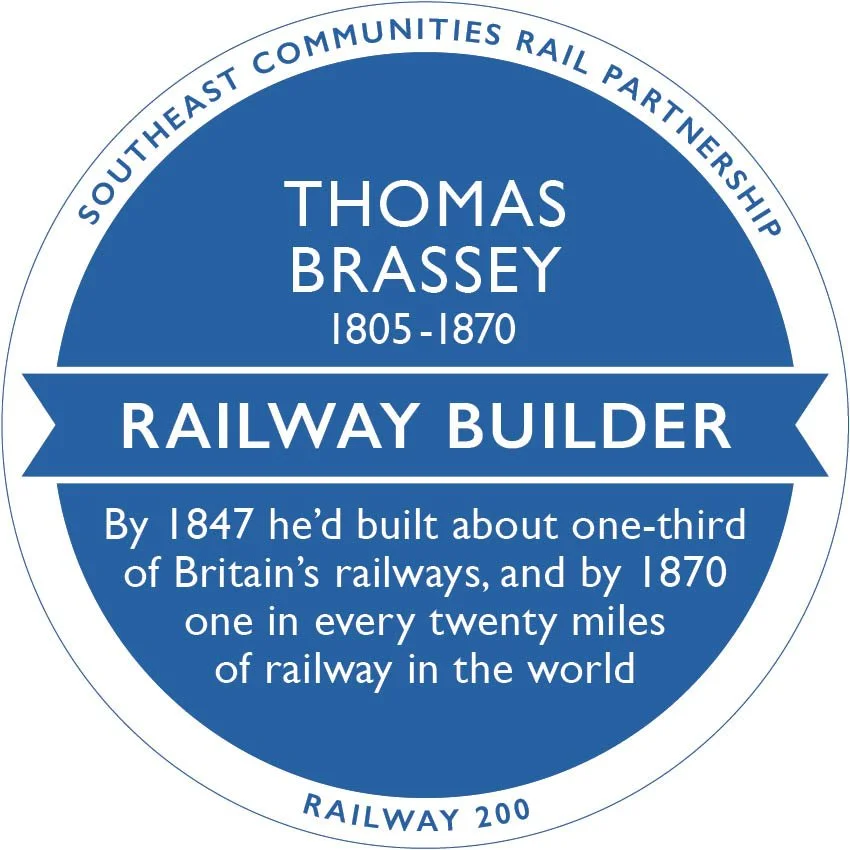
“At one point, Brassey had railway work progressing in Europe, India, Australia, and South America with a labour force estimated at 75,000”
-
b. Buerton, Chester 1805
d. St Leonards, East Sussex 1870“During a 40 railway building career he built one third of UK railways, three quarters of railways in France. 1 in 20 miles of the world’s railway network. Bridges, viaducts and stations” according to the Thomas Brassey Society.
In 1831 he married Maria Harrison, and they had three children: Thomas, Harry and Albert.
His career “began as an apprentice surveyor, then a partner and sole manager. In 1835 (aged 30) he built a section of Colorado railroad; assisted on the London to Southampton line; in 1841-43 he built the Paris-Rouen railway, and other lines in France, the Netherlands, Italy, Prussia and Spain; the Grand Trunk Railway in Canada (1,100 miles of track 1853-59) with Peto and Betts., as well as the Crimean Railway (1854).
At one point, Brassey had work progressing in Europe, India, Australia, and South America with a labour force estimated at 75,000. (Britannica)In the late summer of 1870 he took to his bed at his home in St Leonards-on-Sea. He was visited there by members of his work force, not only engineers and agents, but also navvies, many of whom had walked for days to come and pay their respects. (Tom Stacey biography)
On 8 December 1870 he died from a brain haemorrhage in the Victoria Hotel, St Leonards.

“Over and over again Florence replaced amputated limbs with an artificial one, and successfully induced the railway companies to receive these men again”
-
Florence Jessie Dolby was born in Kensington to retired army Capt. John and Jessie Dolby. She was a woman of independent means.
Around 1892 the necessary funds for a purpose-built railway Mission Hall and adjoining convalescent home for railway men on Portland Place, Hastings were raised from donations . Mission Halls were common nationwide for religious, social and Temperance classes but this was to be the very first convalescent home specifically for railwaymen.
In a promotional piece in a Mansfield newspaper of 1894 Florence, the Honorary Superintendent, described the Home hoping to encourage subscriptons and donations to help fund a much larger home.She wrote that 200 patients from 16 railway lines had already been treated in its first two years, though only 12 at a time. Some had suffered injuries or amputation following accidents, others were treated for “heart disease, influenza, rheumatism, and consumption being the most prevalent” though “no nurse was kept”, that task fell to Florence herself and two honorary doctors. The Home was supported by voluntary contributions. and “subscribers of one guinea are entitled to recommend one patient for three weeks at a charge of 5s. 6d. per week.”
An article in the London Echo in 1895 described how “the lady connected with it has over and over again first replaced the amputated by an artificial limb, and then successfully carried through the much harder task of inducing the railway companies to receive these men again, being quite as capable as before”.
The Home did move to much larger premises in 1897 where 40 beds could be accommodated. It was at 111 West Hill Road, St Leonards, close to Bo Peep junction, described in the Railway News as “one of the loveliest spots... standing on a cliff, overlooking the sea”. It was built on a site purchased by Miss. Dolby herself.
In 1901 Lancashire-born Jane Mercer was the nurse there with six other staff such as a cook and housemaids for its patients.
Florence retired from her work in her 50s through poor health. The following year she married the Home’s secretary the Rev. William Gray and they moved to Beckenham and later Rochester where she died in 1935, aged 85.
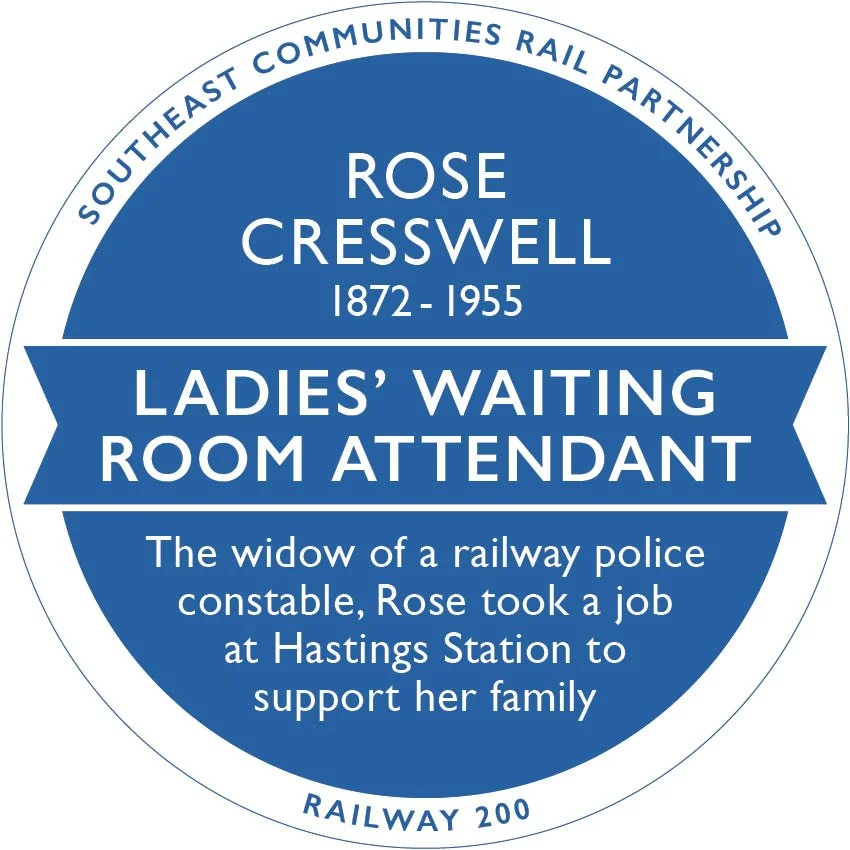
“Widowed at 46, Rose took work as a ladies’ waiting room attendant for at least 20 years”
-
Rose was born to Caroline and Henry Harris, a shepherd near Wanborough, Guildford in 1872, one of at least eight children.
She married Richard Cresswell, a railway porter, in 1901 and they were living in Dorking. They had a daughter Lilian and a son Richard Henry. By 1911 they’d moved to Mount Pleasant Road, Hastings and her husband was now a railway police constable. He died in 1918, aged 45, the cause is unknown.Now a widow Rose took a job as a ladies’ waiting room attendant at Hastings station. According to records, a job she still held in 1921 and 1939, and where she and now 28 year old son Richard (a wholesale grocer’s travelling salesman) had moved to Milward Road.
Rose died in Hastings in 1955 - some 37 years after her late husband. She was 82.
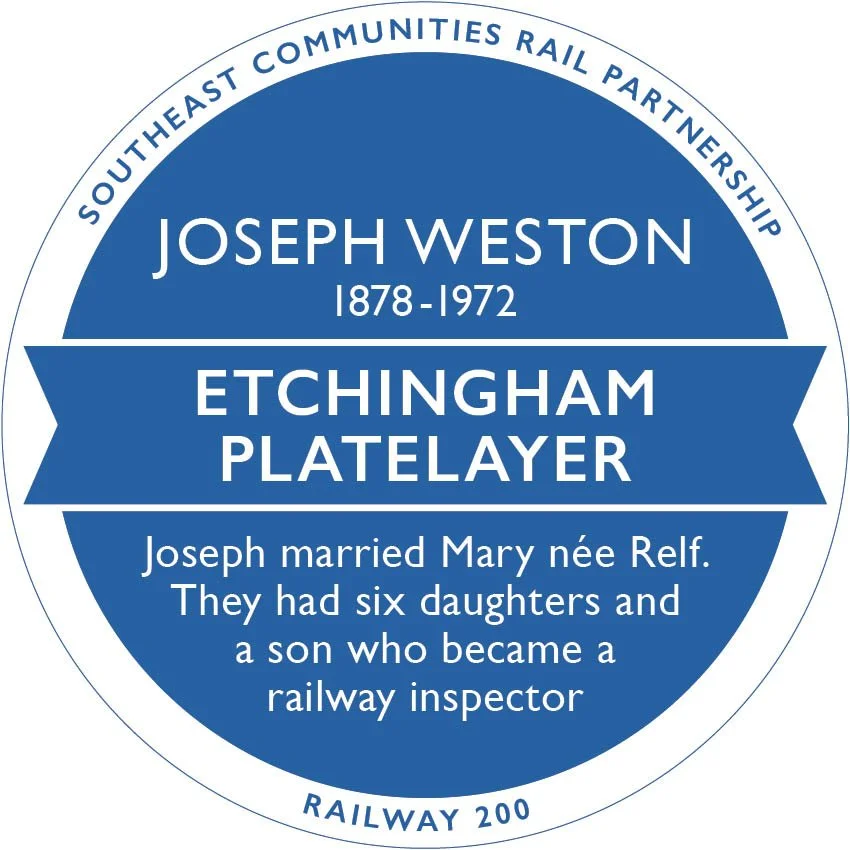
“In 1901 Joseph was living at Etchingham Station itself, where his father was a labourer at the creamery there”
-
Born in Ticehurst in 1878, Joseph was labouring on a farm by the age of 13, before becoming a railway labourer. In 1901, aged 22, he was still living at home - which at this point was Etchingham Station itself, where his father was a labourer at the creamery there.
Joseph married Mary Relf in 1904, and they had seven children - Irene, Olive, Albert, Evelyn, Marjorie and twins Bessie and Florence. From around 1921 to 1939 Joseph worked as a platelayer or lengthman for the railway around Etchingham, and living at 5 Rother View on Church Lane where it passes over the railway line.
Daughter Irene was living next door with her railway lengthman husband Ernest Wells at No 6! Son Albert was later living in St Leonards-on-Sea and was a railway engineer’s ganger for Southern Rail.
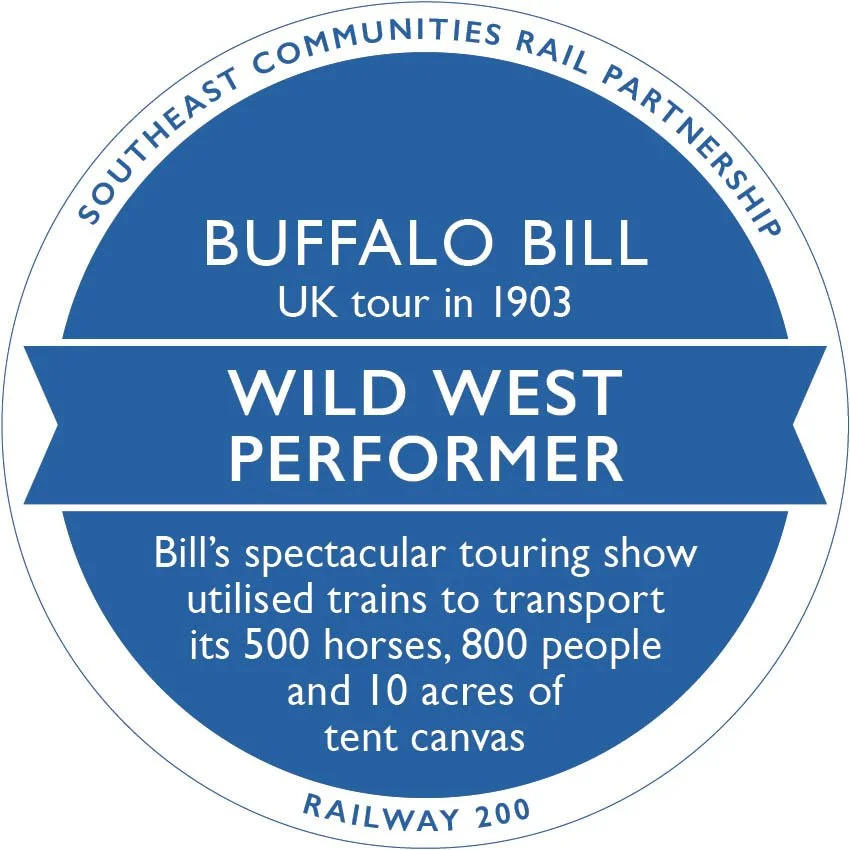
“Offering thrilling episodes, escapes, marksmanship and unique pastimes of wild west life the cast included 100 native American performers from the Sioux, Ogallallas, Brules, Uncapappas, Cheyenne, and Arapahoe tribes”
-
When Buffalo Bill’s touring Wild West extravaganza visited England in August 1903, its itinerary included Brighton, Guildford, Tunbridge Wells, Eastbourne, Hastings and on to Ashford and more of Kent.
For one day only, at each town stop, the hundreds of participants performed “twice daily, come rain or shine”, before dismantling and moving on by train to the next location.The local press advertisements declared Col. W. F. Cody (Buffalo Bill) would utilise four special trains to convey 500 horses and 800 people. Offering “thrilling episodes, struggles, escapes, adventures, marksmanship, and unique pastimes of Border life. 100 Redskin Braves, including the famous Warriors of the Sioux, Ogallallas, Brules, Uncapappas, Cheyenne, and Arapahoe tribes in Indian pastimes and Dances. Cowboys and Cowgirls in true pictures of the Western Plains... [a reenactment of] The Attack upon the Deadwood Stage Coach... and The Battle of San Juan Hill. All the exciting events of actual warfare and battle... Intense and vivid in its actuality. ... Buffalo Bill, the master exponent of horseback marksmanship, in his wonderful exhibition of shooting
while riding a galloping horse.” Sideshows included snake charming and the “human ostrich, who partook of repeated doses of indigestible articles”. When the Congress of Rough Riders of the World pitched their tents in Buckshole Field, Hastings on 20 Aug 1903, for example, “the weather in the evening was of the hurricane character but the performance was gone through all the same”.
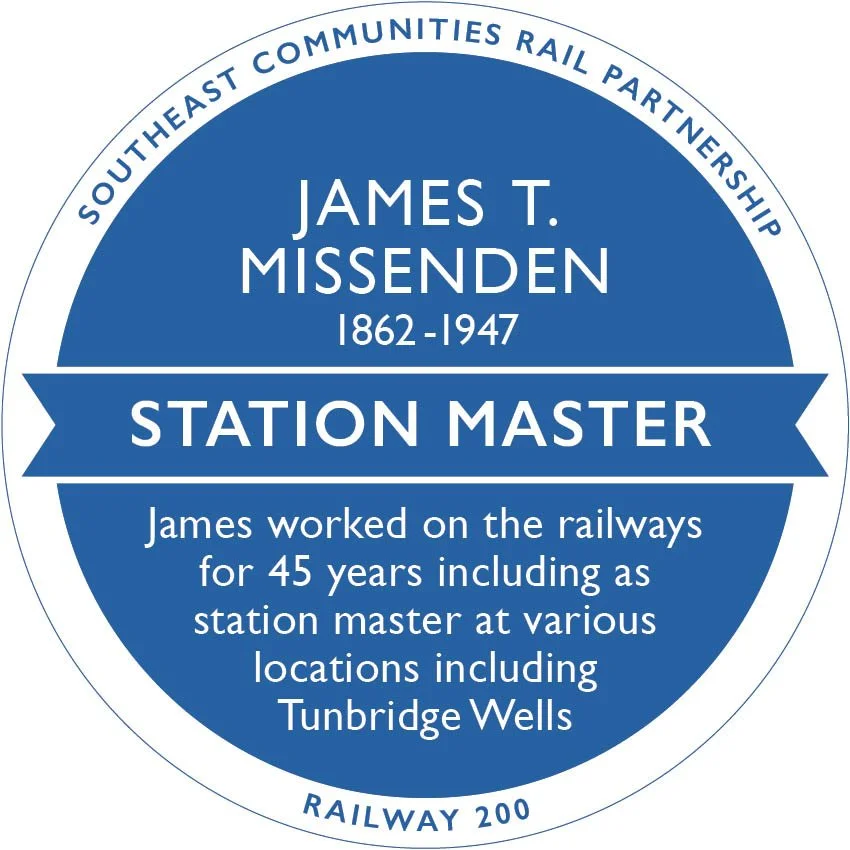
“James was President of the South East & Chatham Railwaymen’s ‘Undaunted’ Cricket Club. He and his wife Lucy celebrated their 60th or diamond wedding anniversary in 1943, and died just 10 weeks apart”
-
b. Bletchley 1862
d. Southborough 1947The son of a Bletchley labourer, James worked on the railways since he was about 18. Variously stationed at Westerham, London Bridge, Ashford, Folkestone Harbour and Bishopsbourne. Appointed station master at Bishopstone in 1901 followed by New Romney and Littlestone-on-Sea, Addiscombe Road Croydon and Blackheath. In 1917 became station master at Tunbridge Wells and Southborough in 1922, and after railway grouping he took over Tunbridge Wells West before retiring in 1927.
In the 1920s James was President of the South East & Chatham Railway men’s ‘Undaunted Cricket Club’In 1943 James and his wife Lucy née Alcock celebrated their diamond wedding anniversary (60 years). He died aged 85 at Carville Avenue, Southborough, Tunbridge Wells on 1 January 1947; his wife Lucy died just two months later on 12 March.
One of their children was Eustace Missenden.

“At its height, around 250,000 navvies worked on the railways’ huge earthworks projects, and in the days before health and safety, thousands of accidents and many deaths occurred”
-
“Last Saturday [23 May, 1846] a lad, named Rock, met a dreadful accident on the railway works at Bopeep. One of the laden earth carts was being drawn over the bridge, and, as is usual, the horse unhooked a short distance from the ‘tip,’ when the lad fearing that the animal would run over him, jumped on the rails, and the cart came along and smashed his right leg in a shocking manner. He was taken as soon as possible to the Infirmary, where amputation of the injured limb was found necessary. At first slight hopes were entertained of the lad’s recovery, but we are happy to say that he is now going on well.”
Hastings & St. Leonards Observer, May 1846.Navvies were largely an itinerant workforce of manual labourers, originally excavating and building Britain’s network of ‘navigations’, the canals.These men were soon needed to build the railways, moving around the country wherever the work took them, where encampments were set up to house them. At its height, around 250,000 navvies worked on the railways’ huge earthworks projects, and in the days before health and safety, thousands of accidents and many deaths occurred. As early as 1839, Parliament wanted railway companies
to keep records of such injuries and fatalities on their construction sites. but not all did. And navvies weren’t necessarily considered railway employees and so could conveniently be excluded from the statistics.
Sadly we’ve been unable to identify Mr Rock or what happened to him.

“For Rye station building, William chose an Italianate style, and for Battle he gave a nod to the Abbey’s medieval architecture by facing the station in French stone from Caen”
-
b Faversham, Kent 1800
d Redhill 1859
Architect William already had experience of employing eclectic styles from a Gothic London church to a ‘plain’ London school. When the commission to design over a dozen railway stations in a short space of time for the South Eastern Railway’s new line from Tonbridge to Hastings he didn’t offer one template to be replicated. Some of the smaller stations were given a rather homely, brick building, while for others such as Rye (c.1850) he chose an Italianate style. In his design for Battle railway station, faced in Caen stone (1852) he gave a nod to Battle Abbey’s medieval architecture. He also created rural stations for Winchelsea, Appledore, Ham St, Wadhurst, Frant, Stonegate, Etchingham, Robertsbridge, Crowhurst and the original Hastings station which was replaced in 1931 (and again in 2004).
William had three daughters by his first wife Ann. After her death he had a son by his second wife Emma. William died in 1859 at his home Red Hill Lodge, in Redhill, Surrey.
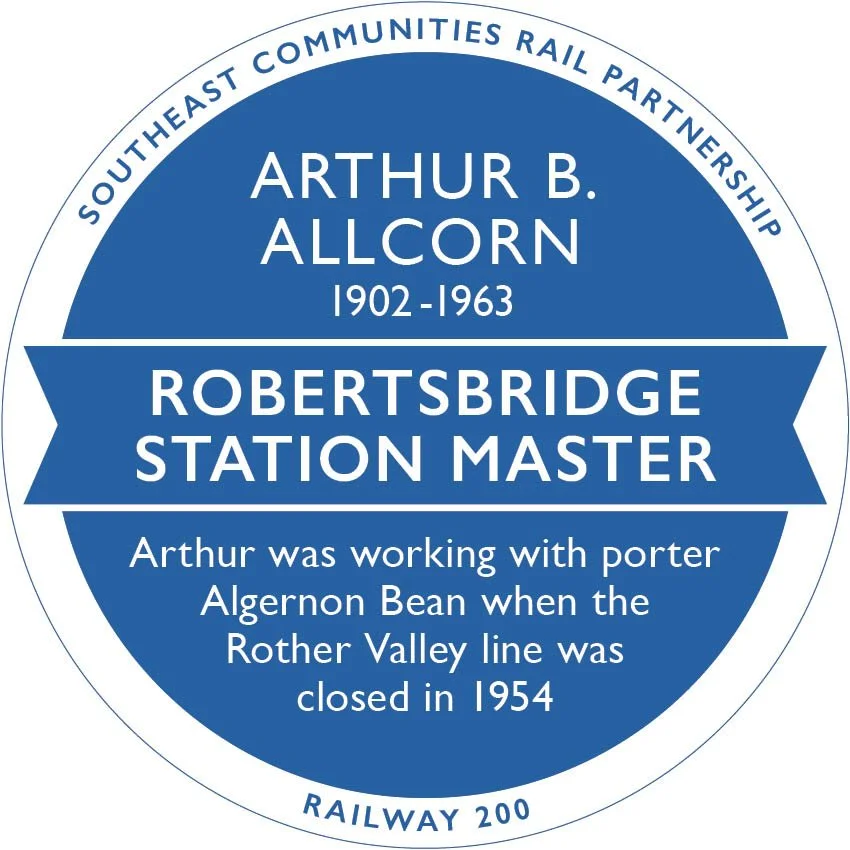
“One passenger recalled: one cold snowy day I travelled to the station in my high stiletto heels. Mr. Allcorn noticed and insisted I borrow his wife’s wellingtons”
-
Arthur Bertram Allcorn was born in Smarden in 1902, one of four children to Eliza and William, a domestic gardener. By the time Arthur was 19 he was a South Eastern & Chatham Railway booking clerk in Wye, Kent. He married Norah Ridley, and they had a daughter Rosemary. After a period in Tenterden Arthur was promoted
to station master at Robertsbridge.
One passenger recalls Arthur was “always very smart in his dark suit and peaked hat with gold braid trim. Mr. and Mrs. Alcorn lived in the house attached to the ticket office and had a large garden - where the extended car park is now. There were very few commuters in those days, but Mr. Alcorn was very protective of them. On the days my mother drove my father to the station Mr. Alcorn would ring up to let her know if the evening train was running late so that she was not kept waiting at the station. On one cold snowy day I travelled to the station in my high stiletto heels; Mr. Alcorn noticed and insisted that I borrowed Mrs. Alcorn’s wellingtons.”
On 2 January 1954 the single track Rother Valley Line between Headcorn and Robertsbridge closed after 50 years. On its final day over 1000 passengers rode the six-coach train with its two 1870s Stroudley Terrier engines, puffing along at 25 miles an hour. The driver was Fred Hazel, fireman Robert Blair and signalman-porter was Algernon Bean. Some passengers wore mourning dress, but the atmosphere was more of a picnic, a celebration with singing and numerous toasts, and at one station a shot gun salute rang out, at each level crossing there was a “cacophony of shouts and motor horns” and at another two bugle boys played the Last Post.
Arthur died in 1963.

“Working up the ranks from railway office boy to General Manager, Eustace was awarded an MBE, an OBE and a Knighthood, and a Southern Railway engine was named in his honour”
-
b. New Cross, London in 1886
d. Rudgwick, Horsham 1973Son of a station master, he began working life as a junior railway clerk. He married Lilian Gent in 1912. By the 1920s he was London District Traffic Superintendent for SE&CR. In 1935, he headed a contingent of railway officials on a trip to New York. He rose to become General Manager of Southern Railway, and later first Chairman of the Railways Executive.
He’d been awarded an MBE in 1925, an OBE in 1937’s Coronation Honours, and Knighted in 1944, having overseen the dispersal of over 180,000 troops by rail as they were rescued by small boats from Dunkirk.
Eustace even earned the honour of having a train named after him (featuring in a 1949 Pathe News segment). He died in 1973, aged 86.

“Lottie’s family had a bakery at 27 Denmark Street, Wokingham into the 1950s. After her death, a wooden footbridge was erected over Langborough crossing”
-
Seven year old Lottie Martin was out picking primroses with her sister Mary and their 19 year old nurse maid Ellen Bird on Wednesday 18 April 1883. At Langborough railway crossing Lottie sat on the stile as they waited for a luggage train to pass shortly before 6pm; she promptly jumped down to cross the tracks. But at the same time a London & South Western passenger train, running 3 minutes late and obscured by the first, was coming in the opposite direction. Totally unaware, Lottie was struck by it and killed immediately. The driver himself, Edmund Mann, didn’t realise what had happened until he received a telegram on his train’s arrival at Reading Station.
Lottie was born in Wokingham in 1876; the youngest of six children to Hannah Smith and local baker Henry Martin, whose bakery was at 27 Denmark Street, Wokingham for many years (where The Lazy Frog Massage shop is now). Her brother Weston, a fire brigade member and baker like his father, continued the family’s bakery business until his death in 1955.
A few months after Lottie’s death, a wooden footbridge was erected over Langborough crossing, and the Railway Co. decided to build a permanent bridge and a new station building at Wokingham.There’s a Wokingham Society blue plaque commemorating the unusual construction of the bridge in 1886 ‘from re-used rails’.

“Widowed Charles remarried and was actually living right beside Winnersh station. His son Ernest worked for John Warrick, the Cycle & Motor manufacturer making bodywork for three-wheeled delivery motor vehicles destined for Selfridges and the Post Office”
-
Charles was born in Slough in 1878, one of 9 children. He was employed as a cabinet maker, and married a lady called Elizabeth. By 1911 they were living at 70 Cromwell Road, Caversham with their two young children Ernest and Dorothy. Sadly Elizabeth died at 44. Charles remarried a couple of years later to Marian Parker and they had a daughter together, Marion Joyce.
By 1921, Charles and his family had moved to 19 Lorne Street in Reading. He was working as a carpenter and joiner for the Great Western Railway’s signal department on Caversham Road - possibly making the wooden semaphore signals, or even the woodwork of signal boxes themselves? Son Ernest, now 16, was a turner and fitter for John Warrick the Cycle & Motor manufacturer; who at the time was making bodywork for three-wheeled delivery motor vehicles destined for Selfridges and the Post Office.
Charles was still working as a railway carpenter during the Second World War, he was in his 60s, and was actually living right beside Winnersh station in 1939 (or Winnersh Halt as it was known then) at the house called Lockesley, at 19 Robin Hood Lane.
Daughter Marion’s husband Victor McLeonards was the son of an aeronautical engineer, and grandson of another railway carpenter at Caversham Road signal works - a colleague of his father-in-law Charles Sharpe!?

“Elsie’s piano making father was killed in action in 1916 when she was only 4. In the 1930s she worked for GWR, updating departure times and platform numbers”
-
Elsie’s mother Rosa Shuff was a housemaid until her marriage in 1911 to London piano maker Albert Lindsey. They were living in Finsbury Park when Elsie was born. Albert was called up for World War I in 1915 and was serving as a Private in the Royal Fusiliers when he was killed in action on 27 July 1916, aged 31. Elsie was only 4.
Rosa was from Caversham and she and Elsie moved back there during the war and by 1921 they were living with seven relatives at Rosa’s parents house Dean’s Farm Cottage, near the Thames. Elsie’s uncle Walter lived there too - he was an engineman for Great Western Railway. In 1939, aged 27, Elsie was working for GWR herself, as an indicator board operator - updating departure times and platform numbers. Elsie and her mother were living at 6 Erleigh Court Gardens in Earley by now.
Elsie married Norman Parlour in 1941 and appear to have had two children. Norman was a seedsman’s clerk - presumably at Sutton’s Seeds - a company who benefitted from the railway at Reading to handle large consignments of seeds and bulbs.
Elsie’s mother, who was widowed at 25, never remarried, and lived to the ripe old age of 100. Elsie herself lived to 2003, she was 91.

“In The ABC Murders each victim has a railway timetable left by the body; in 4.50 From Paddington a train passenger witnesses a murder in a slowly passing train; and in Murder on the Orient Express a murder occurs on a glamorous, snowbound train”
-
The best-selling novelist of all time - the writer of 66 detective novels - Agatha Christie loved train travel and was fond of using trains in her novels, as crime scenes for example. Sometimes they’re such a big character in the book they feature in the title. In The ABC Murders (1936) each victim has an ABC Railway Timetable left by the body; in 4.50 From Paddington (1957) a train passenger witnesses a murder in a slowly passing train; and in Murder on the Orient Express (1934) inspired by real events, a murder occurs on a glamorous, snowbound train.
Agatha and her first husband, businessman Archie Christie, moved to what had been described as an ‘unlucky house’ in Sunningdale in 1924. It was close to the railway station, so Archie could commute to his job in London. In 1926 Agatha’s mother died and a few months later Archie asked her for a divorce, having fallen in love with someone else.
In December Agatha’s car was found abandoned on the North Downs, close to where her husband was spending the weekend with his girlfriend. Agatha was feared missing, and a newspaper offered a reward for information.
In fact she’d had a nervous breakdown and used the train to ‘disappear,’ travelling as ‘Mrs. Neele’ - her husband’s lover’s name. She was discovered 11 days later in a Harrogate hotel having been recognised by staff.The following year Agatha began her next work - a Poirot novel called The Mystery of the Blue Train set on a luxurious train from London to the Riviera. She put her ‘unlucky’ Sunningdale home on the market and after her divorce was complete, she set of to see friends in Istanbul on the Orient Express...!
In 2023 as part of its ‘100 Great Westerners’ series GWR named the Intercity Express train 802110 ‘Agatha Christie’

“George had been serving in Palestine but his whereabouts were unknown and was presumed dead by his family. After his surprise return he retrained to work on the electrification of the railways”
-
George Edward William Gibbins was born in Oxfordshire in 1898 to Catherine and James Gibbins.
In his teens, George joined the Royal Army Medical Corp as a Private, marrying Elizabeth Gale on Christmas Day 1919. George returned to the army and served at their Headquarters in Lod hospital in Palestine in 1921.
Meanwhile back in England, his wife Elizabeth and their daughter were living with his parents in Kingston-upon-Thames. Elizabeth, now 24, was working as a pantry maid at a hotel, describing herself as a widow, suggesting George’s whereabouts were unknown and presumed dead. But happily George did survive his time in the army and the family were reunited.
By 1939 they were living at a house called Sonoma on Watmore Lane in Winnersh - with possibly four children. George, now 40, had retrained and was working for Southern Rail as an ‘electric track lineman’ as part of the railway’s electrification using the ‘third rail’ system as the region transitioned away from steam.
George lived until 1970, he was 71.

“Charles and Annie would have 8 children though only five survived. Their son Charles Jnr. became a gateman and porter, and grandson Cyril became an engine fireman and driver”
-
Charles was born in Dunsden in 1872, one of at least six children to parents Mary Ann Hamblin and husband Henry Willoughby, an agricultural labourer. After leaving school Charles worked on a farm, marrying Annie Purton in 1896.
By the time of the 1911 census, now aged 39, Charles described himself as a railway labourer and platelayer (laying and maintaining the tracks) and living with his family at Matthews Green, Wokingham. Charles and Annie would have 8 children in all, though only five survived: Sons Edmund and Charles and daughters Elsie, Gertrude and Lilian. Lilian went on to marry Reginald Brown, a former railway navvy - a tough, often dangerous, job of heavy, manual labour, building railway bridges, cuttings and tunnels, with little more than picks, shovels and gunpowder.
A decade later Charles is still platelaying, with the family now living at 144 London Road, Wokingham (opposite Froghall Green, where St Crispin’s School is now). He died in 1932, aged 59.
His son Charles was a railway gateman - manning level crossing gates - for South Eastern, though by 1939 he’d become a railway porter with office duties, and particularly at Winnersh Station after WWII. He was living at 9 Barkham Road, just yards from Wokingham Station (and Lottie Martin’s railway bridge!) with his wife Edna May and their seven children including Gladys, Leonard and Cyril.
Cyril Willoughby (Charles’ grandson) started working on the railways himself when he was 15 years old, becoming a ‘fireman’ on the steam trains when he turned 16. He went on to drive trains from the age of 23 - steam trains initially and later diesels and electric - working the Reading-Waterloo line through Winnersh much of the time - until his retirement.

“Two race day trains collided, crushing the guard’s van at the rear to ‘splinters’. Victims’ injuries were often described in the newspapers in all-too-vivid detail. Five men died at the scene, the sixth died a few days later”
-
A racecourse, a ‘Royal Racecourse’ at Ascot was first established in 1711 by Queen Anne. With the coming of the railways Ascot station opened in 1856, welcoming its first race-goers by railway in 1857.
Ascot’s first day of racing in 1864 was Tuesday 7 June. The Prince and Princess of Wales (the future King Edward VII and Queen Alexandra) were in attendance. Racing had been running late and railway officials were concerned about the sudden rush of passengers. Trains were run rapidly one after another. There was an on-board altercation at Egham about card sharpers on one train which lead to a short delay, but it was enough for another crowded train behind to catch up, despite it not travelling at a great speed. At about 7.45pm these ‘special’ race day trains collided, crushing the guard’s van at the rear to “splinters” but luckily the guard had jumped clear. Described in the Buckingham Advertiser as “those long, unmanageable trains, heavily laden with holyday makers”.
Five men died at the scene, a sixth dying from his injuries a few days later. Injuries were often described in the newspapers in all-too-vivid detail that we shan’t repeat here.Those who died were: William Winfield, gardener to Mr Bracebridge, Sherbourne; Edwin Hall, corn chandler, 6 Duke St, Manchester Sq, London; John Cobbett agent to racing celebrity Mr Padwick, Hill St, Berkeley Square, London; Robert Wilkie, publican Glove Inn Kings Road, London; Joseph Clegg, publican Harp Inn, Jermyn St, London; Esau Trigg, Brighton publican (Hero of Waterloo Inn) 34 Lower Market Street, Hove - died a few days later at Charing Cross hospital

“At first treated with suspicion and hostility, eventually she was just one-of-the-boys and welcomed into the card games in the smokey mess room.
‘What can compare to the view from the front cab of a train rushing through a snowstorm at 90 mph’”
-
Born in Sussex, Helena trained as a GPO switchboard operator, which led to a job as a telephonist in British Rail’s Southern Region at Waterloo in 1977. She realised very quickly that the job didn’t suit her. She disliked being on the periphery of the railway industry not in the thick of it.
Stories of a colleague’s husband’s new career as a guard piqued her enthusiasm. The Sex Discrimination act had come into force a couple of years before - promoting equal opportunities regardless of gender - so encouraged by her female colleagues to become the ‘first lady guard’ Helena filled in the application form.
Needless to say her application progressed grudgingly; they hoped a medical exam and tough training courses would weed her out as an inadequate candidate but she passed them all. She was in! On her week’s induction, obviously the only woman, she learnt first aid, and about railway rules and laws.Between courses she did a stint at Wimbledon Station. Her first uniform was a male guard’s jacket with jeans and Doc Marten boots. She was treated as a celebrity, the first woman ‘learner-guard’ and treated as one-of-the-boys. On the a shunter’s course she met some hostility. Accused of taking work away from a man. On this course Helena recalls she “had to lift a notoriously heavy ‘buckeye’ coupling’ ... too heavy for any woman to lift. A semicircle of tormentors gathered around sniggering when my turn came. I knew this was the end of my brief sojourn on the ‘real’ railway: not only would I never be a guard, I would exit utterly humiliated and to a chorus of jeers and ‘told-you-so’s’ from my harassers.The thought of this, and the feeling that all women would be judged on my success or failure, gave me the strength to lift it. But there was no applause and no apology.”
The guard’s course followed. Learning how “all the various signalling systems worked, and procedures for dealing with every emergency that could possibly arise: collision, fires, signal problems, derailments, drunks, drug-takers, objects on the track”. She passed with 80% and moved to her depot,Wimbledon Park, where she met a little animosity, “especially from those who had failed the guards’ course”. She was even accused of getting the job through favouritism. Six weeks ‘on the road learning’ involved accompanying senior guards on their shifts, day and night. She was welcomed into the card games in the smokey mess room.
“Seeing the sun rise over a Berkshire field covered with rabbits and set over the Solent were magical experiences.And what can compare to the view from the front cab of a train rushing through a snowstorm at 90 mph” she says.
Sixteen weeks since her application, on 23rd March 1978, she worked her first train alone.The 12:46 return Waterloo to Windsor. She was still only 19.
In her spare time Helena had studied for a degree in Sociology and Social History and she became a full-time historian following a railway career-ending accident in 1999. Her particular focus has been on Victorian women, publishing several books on the subject, including her well-regarded book ‘Railwaywomen’ which took 10 years of research into their hidden histories.
Read Helena’s full reminiscences on the beginnings of her railway career at hastingspress.co.uk/railwaywomen

“Brunel’s French father fled France for the USA during the Revolution and was appointed Chief Engineer of New York City. Back in London he worked on the first tunnel under the Thames with his son Isambard, who at one point was severely injured. During a six month recuperation he worked on designs for a competition to create a bridge across the river Avon in Bristol”
-
Brunel’s French father Marc fled France for the USA during the Revolution and was appointed Chief Engineer of New York City. He moved to London in 1799, married Sophia Kingdom, and was Knighted for the difficult and dangerous building of the Thames Tunnel (now connects Rotherhithe and Wapping Overground stations).
His son Isambard was born in 1806 and picked up his father’s aptitude for mechanics. His education included a boarding school in Hove and the University of Caen, France and later in Paris. He assisted his father on the Thames Tunnel and was severely injured as a consequence. During a six month recuperation he worked on four designs for a competition to create a bridge across the river Avon in Bristol. His winning design would become the Clifton Suspension Bridge - though its construction wasn’t completed in his lifetime, and the designs had been somewhat altered by other engineers.
Other projects of his include the first transatlantic steamship ‘The Great Western’ as well as tunnels, viaducts and bridges most notably for the Great Western Railway such as the brick arched Maidenhead Railway Bridge (1839) and the wrought iron Windsor Railway Bridge.This was opened in 1849, the branch line having been delayed following objections by the Provost of Eton. He demanded no station be built within 3 miles of the college, fearing the College would be ruined because “London would pour forth the most abandoned of its inhabitants to come down by the railway and pollute the minds of the scholars, whilst the boys themselves would take advantage of the short interval of their play hours to run up to town, mix in all the dissipation of London life, and return before their absence could be discovered.”Brunel’s iron bridge is a bowstring-arch-truss construction, 61m in length, in the middle of a brick-built 1500m long viaduct, described in the press at the time as “of novel design”.
It’s the world’s oldest surviving wrought iron bridge (incidentally, the oldest cast iron bridge is Abraham Darby’sacross the Severn gorge dating from 1781 at what is now the village of Ironbridge)

“It is worth being shot at, to see how much one is loved”
-
Queen Victoria had returned from London on the train to Windsor station where she transferred to a carriage to continue on to the Castle. A large cheering crowd of on-lookers had gathered including a group of boys from Eton school. “There was a sound of what I thought was an explosion from the engine, but in another moment, I saw people rushing about and a man being violently hustled, rushing down the street” the Queen later wrote.
It was the sound of a gunshot from a pistol she’d heard, triggered by a culprit “who was very miserably clad”. Two of the Eton scholars Gordon Wilson and Leslie Murray Robertson/Robinson, ‘brave, stalwart boys’ had tackled the would-be assassin Roderick Maclean. Wilson struck Maclean’s weapon with his umbrella while Murray Robertson wrestled him, undoubtedly preventing a second shot, and saving the Queen’s life. According to one press account the pistol was not “heavily loaded, and did not take effect.” Maclean was apprehended by Slough’s loco department foreman John Frost who had accompanied the Royal train.
30 year old Maclean was the last of seven men who’d made attempts on the Queen’s life. He’d left a written statement that morning to say he had no intention of causing Her Majesty any injury, just to cause alarm and draw attention to his ‘pecuniary straits’. Witness statements proved the revolver was bought from a pawnbroker for 5s. 9d. in Portsmouth. His father had had him examined some years before to ascertain if he was of sound mind and had been confined in a Weston-super-Mare asylum for 12 months suffering from insane delusions, with homicidal mania. He was found not guilty of High Treason on grounds of insanity, and spent the rest of his life in asylums.
The public outpouring of support lead to Queen Victoria writing to her daughter Vicky saying:‘It is worth being shot at, to see how much one is loved.’
UCKFIELD, EAST GRINSTEAD & OXTED LINE
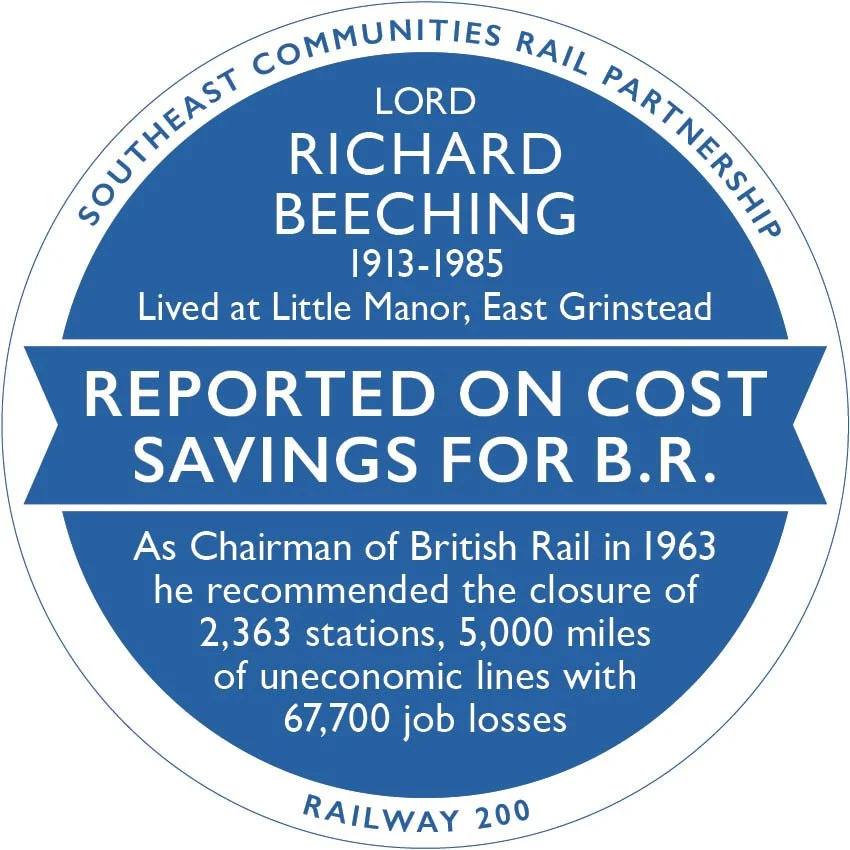
“Beeching’s report was sponsored by the Transport Minister who introduced yellow lines and traffic wardens, a Minister with financial interests in tarmac and road building”
-
One of four sons born to Annie Twigg and Hubert Beeching, a newspaper sub-editor.
Richard was born in Sheerness but his family moved to Maidstone during the war. He was a prefect
at grammar school, studied physics at Imperial College, London and then a PhD. He was senior researcher for nickel extractors Mond Nickel Co. in Birmingham where he lived with his wife Ella.
During WWII he worked on armament design which lead to senior jobs at ICI. In the 1950s freight transport by road was increasing, rail freight revenue was decreasing, causing unsustainable financial losses. By 1960 Richard joined the British Transport Commission’s advisory group on the running of railways, sponsored by the Conservative government Transport Minister Ernest Marples (who introduced the MOT test, yellow lines and traffic wardens for example). Controversially Marples had financial interests in tarmac and road building - a potential conflict of interest?
In 1963 the Commission, reframed as the British Railways Board, concluded that more station and line closures (that had already begun in the 1950s) could save the loss-making network a great deal of money. Their clinical calculations were doubted and challenged, in one example by a 12 year old boy, and their solutions were opposed by the public by 5 to 1. Alternative suggestions to large-scale closures were proposed such as using much shorter trains off-peak to greatly reduce wear and tear costs. But the ‘Beeching Axe’ was largely enacted over the coming years. In 1965 Beeching unveiled the newly branded British Rail, and was made a life peer ‘Baron Beeching’.
He was living at Little Manor, Lewes Road, East Grinstead when he died at Queen Victoria hospital in 1985.
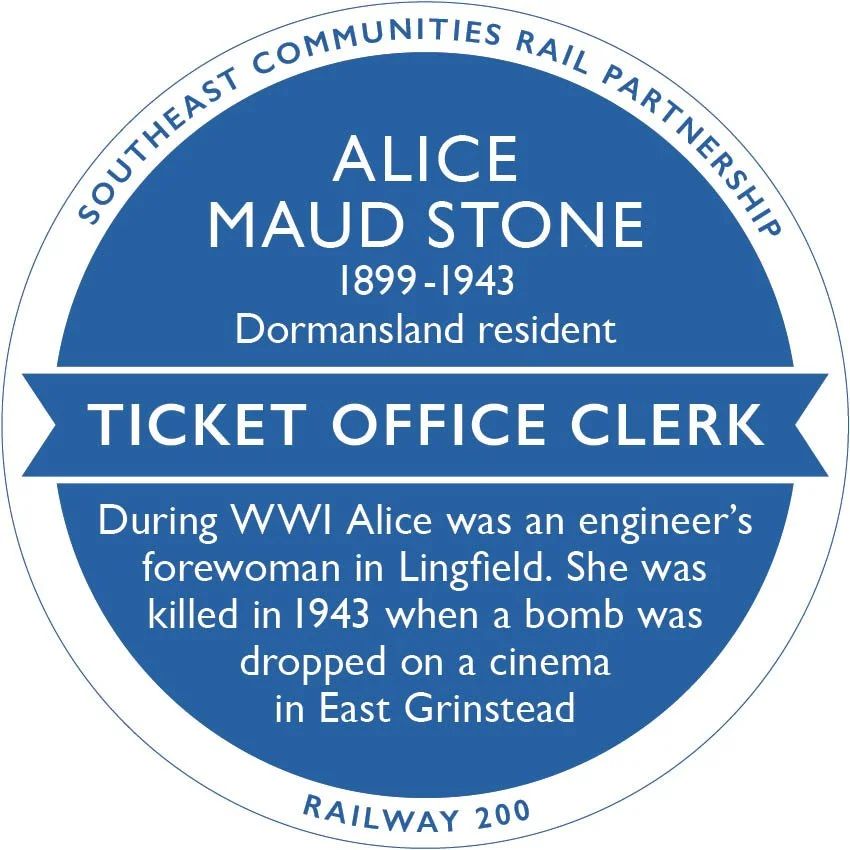
“At 5.10pm on Friday 9 July 1943, as an audience of mostly children were enjoying Hop-Along-Cassidy, a bomb was dropped on Whitehall cinema, killing four women- Alice Stone, Florence Firmin and Erica and Mary Fothergill”
-
Alice was the youngest of five children to house decorator Pharoah Stone and his wife Emily. They were living on Dormans High Street in 1901. Around 1916 Alice worked as a railway ticket office clerk at Dormans station. By 1921 she was the last child still at home, aged 21. She had been working and forewoman for Mr Hales’ engineering company in Lingfield.
She married gas meter inspector Joseph Meadmore in 1931. They had three children Patricia, Joe and Bobbie by 1939 and were living on Sackville Gardens, East Grinstead.During WWII on Friday 9 July 1943 the German enemy approached the town for a daylight bombing raid on East Grinstead. Air raid sirens sounded and the corresponding announcement flashed up on the screen of the Whitehall Cinema. At 5.10pm bombs were dropped on the High Street, destroying shops and the cinema where an audience of 184, many of them children were watching ‘Hop-Along-Cassidy.’
Alice was inside, one of the four adults killed. By chance many of the children owe their lives to being seated at the front of the cinema. Overall 108 people died in that raid, 235 seriously injured. Twenty two of those killed are buried in a communal grave in Mount Noddy Cemetery.There’s an inscription in Dormansland Parish Church to the four women who lost their lives that day: Alice, Florence Firmin and Erica and Mary Fothergill and those civilians of Dormans Land who died in the service of Civil Defence units 1939-45.
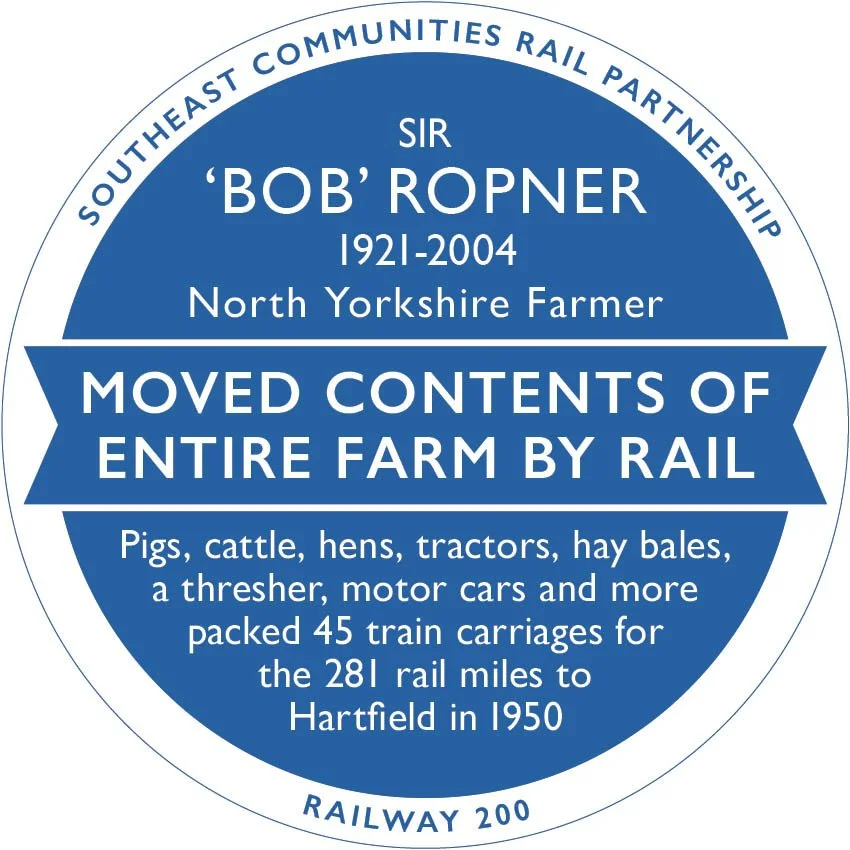
“The move took place overnight in December 1950, there was snow throughout the journey, it took 18hrs 30 mins. A British Transport film crew beautifully recorded the logistical feat of relocating a whole farm across the country by rail”
-
A short British Transport film from 1952 beautifully records the logistical feat of relocating a whole farm, belonging to Robert Douglas Ropner, from one end of the country to the other.
Ian Pearce of the Kirby, Great Broughton and Ingleby Greenhow Local History Group writes that
it “showed the owner of White House Farm, Skutterskelfe, moving all the machinery and all the livestock of his farm as well as household goods and furniture by train from Stokesley Station to Hartfield Station in Sussex and then taking over Perryhill Farm, Sussex... The move took place in 1950 in December and there was snow throughout the journey, which was overnight and took 18hrs 30 mins. 50 wagons were needed and the train was divided into 2 at some point on the journey, the second half following later. The film was narrated by A. G. Street and released in 1952.”The farm was part of the Skutterskelfe estate owned by the Ropner family of shipbuilders and shipowners, and the farmer was no ordinary North Yorkshire farmer but Bob Ropner, a member
of the family. The farm bailiff... Henry Hill... was the only employee from North Yorkshire to move permanently south with the farm. He and his family settled in the south and stayed there even after Bob Ropner gave up farming himself in 1954.
Ropner then started a catering business, but it had little success and he re-located with his family to Switzerland. Inspector Barr, who was the British Rail manager of the journey, returned to Middlesbrough after completing the transfer and the farm workers - looking after the cattle, bull, pigs, ducks, chickens and cat - all returned home to North Yorkshire.”The farmer Robert Douglas Ropner married to Patricia K. Schofield in 1943, they had a son called Robert C. in 1949 who appeared in the film as a baby.
Robert’s grandfather, the original Sir Robert Ropner (1838-1924) was born in Magdeburg, lost his parents to cholera, went to sea but suffered from seasickness and so abandoned his sailing career when he arrived at Hartlepool. There he settled, marrying a local baker’s daughter and gradually building up his business interests to become a shipping magnate.”
Watch the film at the BFI website for FREE here (17 mins): https://player.bfi.org.uk/free/film/watch-farmer-moving-south-1952-online
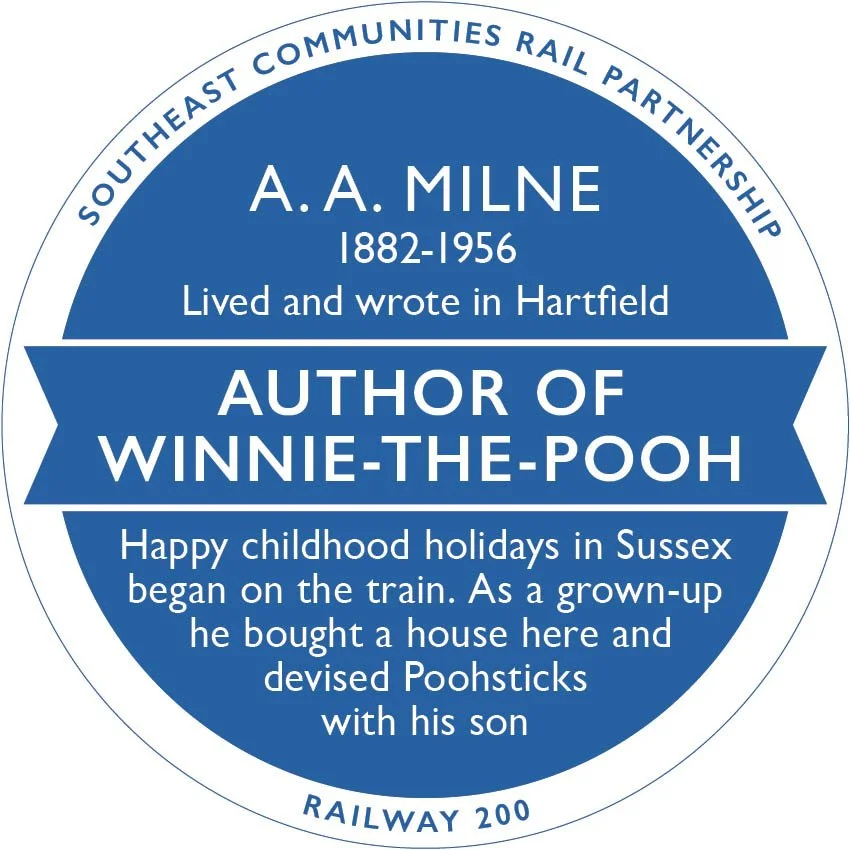
“‘I stand at the door of my carriage feeling very happy. It is good to get out of London. I have nothing to read, but then I want to think. It is the ideal place in which to think, a railway carriage; the ideal place in which to be happy’”
-
“I stand at the door of my carriage feeling very happy. It is good to get out of London. I have nothing to read, but then I want to think. It is the ideal place in which to think, a railway carriage; the ideal place in which to be happy.”
A.A.MilneAs a child, living in Kilburn in London, young Alan Alexander Milne and his brother were often brought out by train from Victoria station into the woods, valleys and fields of Sussex by their father for countryside walks and adventures. Alan recalled that as an 8 year old they once walked 19 miles in a day - fuelled by nuts, ginger beer and ham and eggs - they took in Edenbridge, Hever, Chiddingstone and Cowden station where they took a train to Tunbridge Wells. And before going away to Cambridge University around 1901 he spent time in Hastings where his uncle Alexander was teaching.
By now Alan was writing humorous verse for Punch magazine, and went on to write plays and novels. He married Daphne in 1913, joining the British Army for World War I - as a signals officer at the Somme - but was invalided out. Eventually he was recruited into intelligence to write propaganda.
He and Daphne had a son Christopher Robin in 1920. They left the bustle of the metropolis for the serenity of Cotchford Farm in Hartfield in Alan’s beloved Sussex. It was here that a five acre wood in Ashdown Forest became the fictional Hundred Acre Wood where he would set the stories about a young boy who befriends a bear and other characters. Inspired by a real life bear - the tamest army mascot named Winnie, who had been deposited at London zoo by an army officer from Winnipeg. Christopher Robin was able to befriend Winnie at the zoo, and this inspired his father’s famous Winnie-the-Pooh books.
On National Poetry Day 2017 Tony Knight, a South West train announcer in Wokingham, read AA Milne poems to waiting commuters.
Although he didn’t put Winnie-the-Pooh on a train Milne was clearly a fan. Writing “Nowhere can I think so happily as in a train” he wrote “I am not inspired; nothing so uncomfortable as that. I am never seized with a sudden idea for a masterpiece, nor form a sudden plan for some new enterprise. My thoughts are just pleasantly reflective. I think of all the good deeds I have done, and (when these give out) of all the good deeds I am going to do. I look out of the window and say lazily to myself, “How jolly to live there”; and a little farther on, “How jolly not to live there.” I see a cow, and I wonder what it is like to be a cow, and I wonder whether the cow wonders what it is to be like me; and perhaps, by this time, we have passed on to a sheep, and I wonder if it is more fun being a sheep. My mind wanders on in a way which would annoy Pelman a good deal, but it wanders on quite happily, and the “clankety-clank” of the train adds a very soothing accompaniment. So soothing, indeed, that at any moment I can close my eyes and pass into a pleasant state of sleep.”
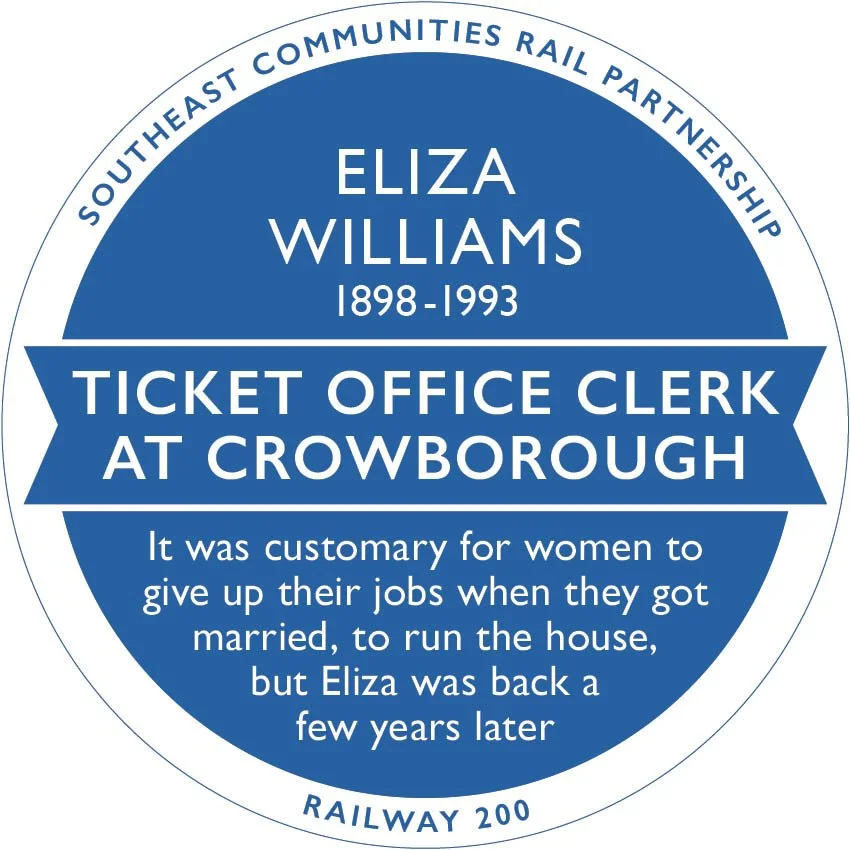
“From 1916 Eliza was a ticket office clerk at Crowborough and then at Rotherfield for the London, Brighton & South Coast railway. She gave up her job when she married in 1926, returning four years later”
-
Eliza Louisa Williams was born on New Road, Rotherfield around 1898, the only child to Ellen Izzard and Arthur Williams, a railway platelayer and underman.
From 1916 she was a ticket office clerk at Crowborough, and continued in that role at Rotherfield for the London, Brighton & South Coast railway according to the 1921 census. Around this time the family, still on New Road, had a lodger, one of Eliza’s fellow railway clerks called Gladys Carpenter.In 1926, ten years into her job, Eliza married a nursery gardener and fruit grower called Harold Hammond. He appears to be the youngest of nine children, and had been working as a gardener since he was at least 14. He was wounded while serving in the First World War.
In those days it was expected of a newly married woman to give up her job to have a family and run the marital household. Eliza was no different. However it seems they had no children and this may have contributed to Eliza returning to work four years later. By 1939 they were living near Harold’s plant nursery in the village of Town Row close to Rotherfield station, just a few doors from the Railway Inn. She lived to 95.

“So respected was William that in the church a brass inscription dedicates a small memorial window of stained glass to him of the Prophet Daniel with the words “Was weary’ now at rest” - both paid for by friends and admirers”
-
Born in Hertfordshire in 1826, William married Lydia Brace in Ware in 1843. They don’t appear
to have had any children, none that survived at any rate. By 1851 William was a railway porter at Edenbridge and had progressed to station master there a decade later. In fact he was still station master there over 25 years later upon his death on 29 September 1884, aged 58. Tragically followed just a few weeks later by Lydia on 7 December.Friends erected a simple Latin cross, recumbant, on his grave as a mark of respect. And in the church a brass inscription dedicates a small, “chaste” memorial window of stained glass (by Ward & Hughes) of the Prophet Daniel with the words “Was weary’ now at rest”. The window and plaque were paid for by friends and admirers.

“Established by philanthropists around 1899 as a training school for poorer epileptic children - during the first war adult men needing the Colony’s specialist care services were admitted too. By 1939 it was home to almost 500 patients, Samuel being one of them, until his death in 1940, aged 61”
-
Samuel Archibald Collins was born in the St Pancras area of London in 1879. He worked as a labourer and carman on the railways there. He married Sarah Arnold in 1901 and they had two children Alfred and Florence. He enlisted in July 1916, as a Private, assigned to the Labour Corps of the 520th Home Service Employment Co. providing essential war work on home soil. It’s not known what happened to him but two years later aged 41 he was declared physically unfit to continue. Curiously he hadn’t returned to his wife and family by 1921. In fact he was an ‘inmate’ as they called it, at the Epileptic Colony in Lingfield.
Established by philanthropists around 1899 as a training school for poorer epileptic children - with a capacity for learning - who might otherwise find themselves in senile wards of a workhouse.
According to an article in the British Medical Journal, in its 300 acre site, the colony provided teachers and medical staff, a schoolhouse, and training in laundry, carpentry and gardening.
Treatments included medicines such as bromide, as appropriate of course, as well as regular employment; as much fresh air as possible; organised games and amusements such as concerts; the interest and discipline of school; a largely vegetarian diet and an ‘abundance of sleep’.
Usually home to hundreds of children and youngsters, led by the matron Nora Henson and school teachers Katherine and Annie Caston; suddenly in wartime dozens of men, presumably with brain injuries and symptoms akin to epilepsy, needed the specialist care services on offer too.
Of the 400 inhabitants in 1921, there were other railway workers such as platelayer Harold Trivett, railway fireman Wilfred Stevens and shunter Frederick Sandles, but also the likes of Walter Lucas the footman to Baroness Wedel Jarlsberg and a grocer’s assistant from Selfridges. By 1939 the colony was housing almost 500 patients, Samuel being one of them until his death in 1940, aged 61.

“The bomb comprised of a two-gallon can of fuel inside a travelling basket, attached to an alarm clock set to trigger a fuse at 3am. Crucially an address label on some brown wrapping paper at the scene would lead to a key suspect”
-
Born in Godstone in 1884 to a cattle dealer, Edwin worked initially as a milkman in Horley. By 1911 he was a railway porter living on 2 Marsland Cottages, Station Road, New Oxted with his wife and a daughter, both called Maggie, and a lodger.
Emmeline Pankhurst, the political activist and chief campaigner for British women’s suffrage (the right to vote in public elections), was found guilty on 3rd April 1913 of inciting arson and using bomb tactics, and sentenced to 3 years ‘penal servitude’.
The following morning, Friday 4th April 1913 Edwin Mighell went in to work at 6.30am. He found the gentleman’s lavatory badly damaged, walls bulged out and the roof blown off. It was discovered that an improvised explosive device had gone off during the night, but luckily had failed to work as intended and no-one was hurt.
Comprising a two-gallon can of fuel inside a travelling basket, attached to an alarm clock set to trigger a fuse at 3am. Additionally there was a flask of cycle lamp oil, a slough hat, a firelighter and some saturated cottonwool. Outside a nickel-plated pistol was found that accidentally went off in the postman’s hand, fortunately doing ‘no mischief’. The lavatory adjoined the station’s oil store, so had a fire broken out that would’ve been quite an inferno.
No Suffragist pamphlets were left at the scene, as was often the case, but some brown wrapping paper that would’ve been destroyed was found intact with a department store label and the name Mrs Watkins. Through store records the police tracked down Mrs Watkins’ delivery address, it appeared that her jeweller husband had reused the paper to send a mended item to a Miss Frida Kerry. Frida and her parents were suffrage sympathisers but confessed nothing. Only much later in 1950, after the death of her husband Harold Laski (a professor at the LSE and Labour Party Chairman 1945-46), did Frida finally admit that it was Harold that had planted the bomb.
In July 1932, Edwin’s wife Maggie, the mother of his five children, died of heart failure while hanging out the washing. Edwin married again in 1934, to Martha Riddle, but he died in 1937, aged 53, having been stationed at Oxted for 32 years.
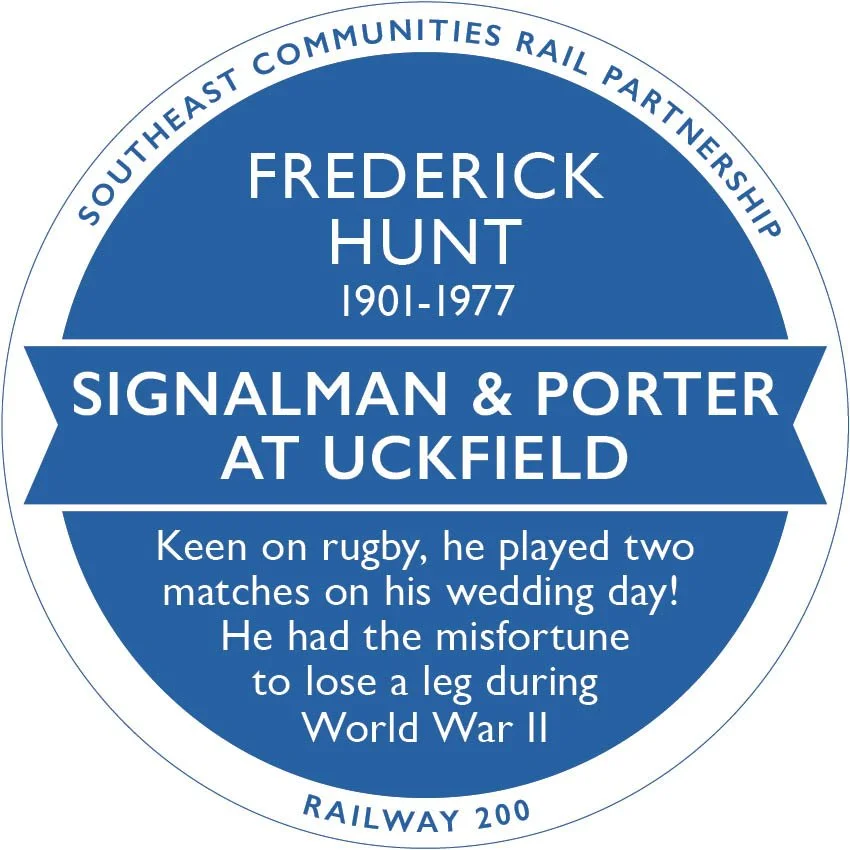
“At Uckfield railway crossing in 1934 an impatient motorcyclist died colliding with crossing gates as they were closed in anticipation of an oncoming train. Porter Frederick dragged the deceased and his motor cycle clear of the line ensuring the safety of the imminent train and its passengers”
-
The son of an Eastbourne dustman born in 1901, Frederick was working as a barman at the King’s Arms Hotel on Seaside, Eastbourne in 1921 before getting a job at Uckfield railway station.
He married Dorothy Gladys Ashman in 1926 but being a very keen rugby right half for Uckfield, he played two matches on his wedding day, one in the morning and another after the Register Office ceremony! The Club gave the happy couple a biscuit barrel as a wedding present, and colleagues at the railway station gave a tea service. They had two children and lived their married life on Vernon Road, Uckfield.
An incident occurred at Uckfield railway crossing in 1934, where an impatient motorcyclist died colliding with crossing gates as they were closed in anticipation of an oncoming train. Porter Frederick, hearing the screeching and crash “dashed down and dragged the deceased and his motor cycle clear of the line” ensuring the safety of the imminent train and its passengers.
Joining the Royal Engineers to participate in World War II, he served in France, where he was involved in ‘Little Dunkirk,’ the evacuation of over 21,000 troops from the fortified town of St Malo in 1944. Afterwards he was sent to North Africa where he had the misfortune to lose a leg, but returned to Uckfield where, with the assitance of an artificial leg, he was able to resume work, now as a signalman.
He retired in 1967 and died aged 76.
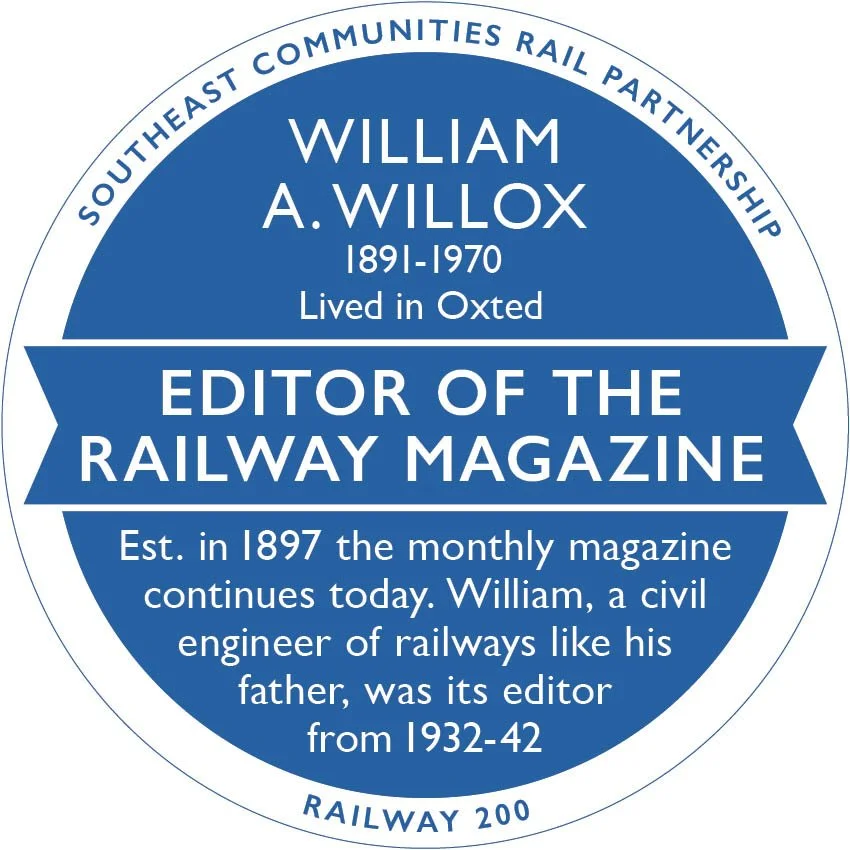
“Launched over 120 years ago by two former railwaymen suspecting a market amongst fellow rail enthusiasts The Railway Magazine features illustrated articles covering specific locomotives and carriages to major railway lines, junctions, tramways and light railways and how they function. The son of a railway engineer, William was its third editor”
-
Launched in 1897 by two former railwaymen suspecting a market amongst fellow rail enthusiasts. The Railway Magazine was well illustrated on good paper. The first editor George Nokes grew the circulation to 25,000, until 1910 when he fell out with the founders and started a rival magazine of his own. Both were bought by the Railway Gazette and then amalgamated into The Railway Magazine.
Articles covering specific locomotives and carriages to major railway lines, junctions, tramways and light railways and how they function, to unique railway uses such as Brookwood cemetery railway, milk trains and Queen Victoria’s funeral. New technologies such as electrification and signalling, and reminiscences about steam and lost lines.
William Willox was its third editor from 1932-42. Born in Scotland in 1892 to Elizabeth and William Snr. “a popular railway maker” who was chief engineer of the Metropolitan line for example, and whose work took him and his family abroad for periods of time since two of their daughters were born in the Philippines.
By 1901 the family were in Croydon, in 1911 they were in Dorset, where William Jnr was a civil engineering student. In 1921 William was in a guest house on Station Road in Oxted where he was based as a civil engineer for the LB&SC railway. Still in Oxted when he took on editorship of the magazine in 1932, in 1939 he was living with the Watsons, an architect and his wife on West Hill.
NORTH DOWNS LINE
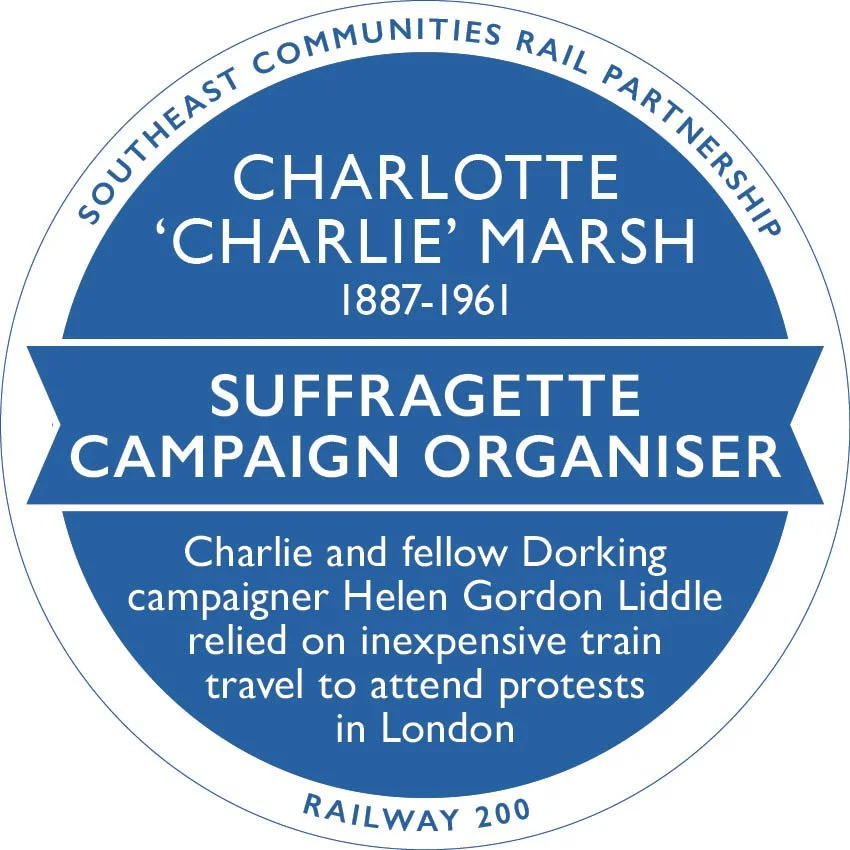
“In 1909 Charlie was one of the first suffragettes on hunger strike to be forcibly fed. Despite or because of her arrest record for direct action and civil disobience David Lloyd George, then Minister for Munitions, employed Charlie during WWI as his mechanic and chauffeur”
-
Born in Newcastle-upon-Tyne in 1887, to Ellen and Arthur Hardwick Marsh, a reknowned watercolourist, Charlotte Augusta Leopoldine Marsh had four sisters and two half-sisters. She was sent to Bordeaux finishing school and had training as a sanitary inspector.
Aged 20, she joined the Women’s Social and Political Union, a campaign group - founded by Emmeline Pankhurst, engaging in direct action and civil disobience - for a woman’s right to vote in UK public elections. Charlotte became a full-time organiser, and would hand out Votes for Women leaflets and parade with placards. However in 1909 she was one of three women arrested for throwing tiles from the roof of Bingley Hall, Birmingham onto Prime Minister Asquith’s car below, in protest of being refused entry to a political meeting. The three were the first suffragette hunger strikers to be forcibly fed, Charlotte a reported 139 times, before her release. She was awarded a Hunger Strike Medal ‘for valour’ by the WSPU.
In the 1911 census, aged just 23, Charlotte was living on Portsmouth, and described as ‘Organising Secretary, Womens Suffrage League’. This was at a time when many suffragists boycotted the census - in fact, written across her census return the enumerator has written “This person... absolutely refuses to fill up paper”. Working from home at 43 Howard Road, Dorking (where there’s a blue plaque in her honour in 1912 Charlotte organised the suffragette campaign and travelled up and down to London by train.
During the First World War when David Lloyd George, the next Prime Minister, was still Minister for Munitions, he employed her as his mechanic and chauffeur. a political gesture, knowing the country relied on women to fulfil mens’ roles during a war.
Charlotte wasn’t wealthy and relied on trains to campaign, attend marches and meetings. Even special trains were laid on for large marches. Occasionally though trains and stations themselves were targets of fires or explosions, such as Oxted station and a train at Teddington, both occuring in the days following Mrs. Pankurst’s conviction for incitement (and 3 year prison sentence) in April 1913, were allegedly the work of militant suffragists.
In the Representation of the People Act of 1918, women (over the age of 30 who met certain criteria at least) were finally given the right to vote. This age limit was brought down to 21 to equal men in 1928, and 18 for all in 1969.
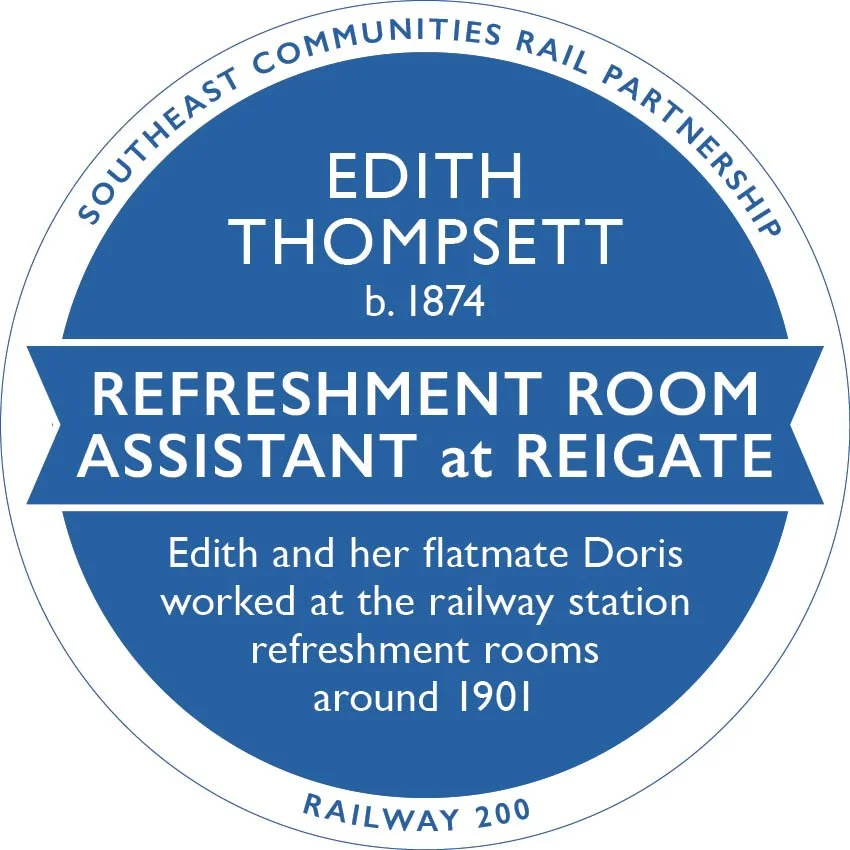
“Edith’s parents had the King’s Arms pub on Seaside Road, Eastbourne and in 1891 she was a barmaid in a Brighton hotel on Queens Road (now Princes House)”
-
Edith’s parents Albert and Henrietta Thompsett had the King’s Arms pub on Seaside Road, Eastbourne. An impressive Victorian building, large enough to house mum and dad, Edith, her six sisters, two brothers and a domestic servant.
Edith was born around 1874 and growing up around the serving of food and drink stood her in good stead. In 1891 she was a barmaid in a Brighton hotel on Queens Road, now Princes House. A decade on Edith and her colleague Doris Jupe were lodging on Clarendon Road, Reigate with the family of railway porter James Titchener. Edith and Doris were working at the refreshment rooms at Reigate station. Unfortunately Edith’s data trail disappears here. She likely marries before the next census, or perhaps boycotts the 1911 census (as Charlotte Marsh did).
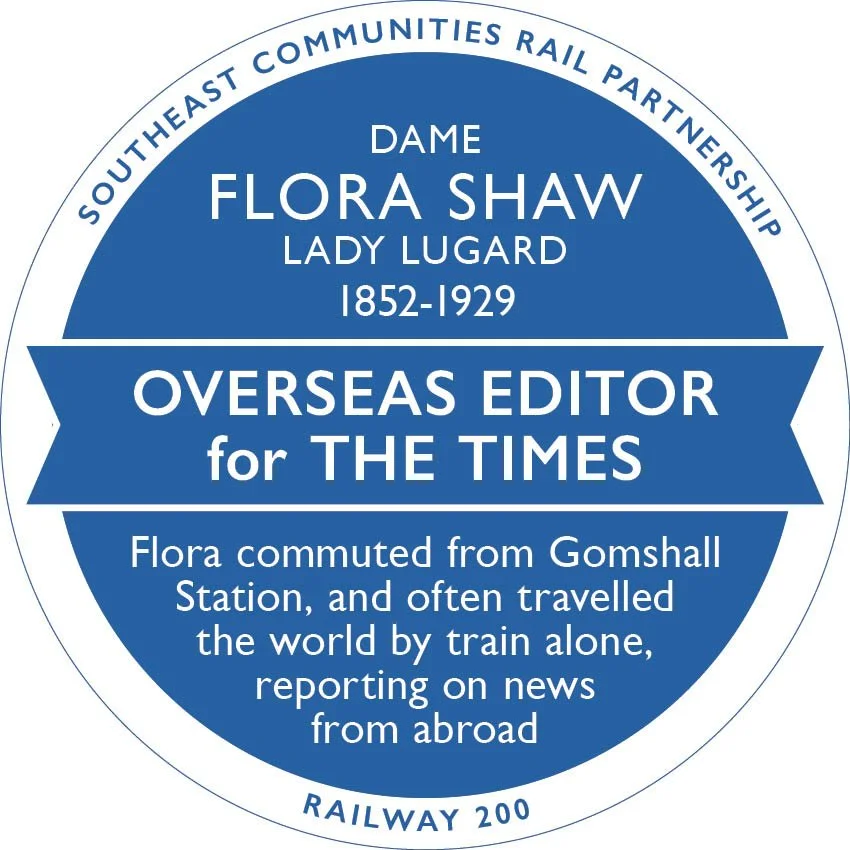
“On a six-day train journey across Canada she described it as ‘a land of clover and roses, the continuity of which is only interrupted by noble waterways and by mountain ranges of magnificent proportions’ and on a train in Australia, her ‘dress caught fire in the blistering heat’”
-
Born in Woolwich, one of 14 children of a Royal Artillery Capt. and his French wife. Flora wrote five novels for children and worked as a journalist.
She was the first female section editor of The Times, Colonial editor 1893-1900, which made her the highest paid female journalist at the time. She travelled daily up to London from Gomshall Station, in the 1890s from her home at Abinger Hammer. In an article for The Times in 1897 she suggested ‘Nigeria’ would be a better, shorter name for ‘Royal Niger Company Territories’.
In 1902 she married Frederick Lugard, and accompanied him in his role as Governer to Hong Kong and Nigeria. She also spent time in the British Colonies such as South Africa, Australia and even the gold fields of the American Klondike – exploring much of it by train - often describing her journeys in personal letters: For example, a six-day train journey across Canada was ‘a land of clover and roses, [...] the continuity of which is only interrupted by noble waterways and by mountain ranges of magnificent proportions.’ She recounted a tale to her sister, Lulu, of how on a train in Queensland, Australia, her dress caught fire in the blistering heat and was only put out by her male companion grabbing the outer layer of her dress in his hands to extinguish it, burning his hands in the process.”
Her enthusiasm for empire as an opportunity for emigration and investment, is distasteful to us nowadays. But she was clearly a strong minded woman, perhaps with an English untouchable arrogance of the day, often travelling alone on railways, often built on English expertise - and investment.

“Lily died at 31. For the funeral, her mother, three brothers, three sisters, uncles, aunts, cousins, all came over from Wales. Lily’s 18 year old sister Elsie stayed, and took on her late sister’s gatekeeping duties”
-
One of the youngest of at least eight children, Lily Florence Goodwin was born to William and Alice in 1918 in Stanleytown, Pontypridd in Wales. Her father and two working age brothers were coal miners.
Lily found her way to Surrey and in 1939 married railway permanentway labourer Frederick Percy. They lived at 234 Worplesdon Road, Guildford before moving to the cottage near East Shalford railway crossing where Lily took on the gatekeeping. It appears they had a son in 1944 they named Royston. Tragically Lily died of a congenital cerebral aneurysm* on 29 July 1949. She was 31.
For the funeral, her mother, three brothers, three sisters, uncles, aunts, cousins, all came over from Wales. Lily’s 18 year old sister Elsie stayed on, and took on gatekeeping duties.

“The orphanage was built on land bought from the London Necropolis Company. Naturally there was school work to do but there were toys to play with - such as a model railway - days out, useful skills to learn such as wood turning and shoe repair, and even a Scout group to join. Mothers could visit once a month”
-
Maintained by railworkers’ voluntary contributions, the orphanage began life in Clapham in 1885 as a home for children up to age 14, whose fathers had died building or working on the railways. It was a very dangerous occupation in those days - and a child’s mother might not be in a position to support them. In 1909 the orphanage moved to larger premises in Woking, built on land they bought from the London Necropolis Company, whose own railway or ‘ghost train’ had been carrying London’s dead from Waterloo to Brookwood Cemetery (in First and Second class carriages!) since 1854.
Born in Bury, Lancashire in 1874 to Susannah and John Core, a paper mill stoker. Her siblings were cotton spinners or weavers but Maria was to spend her working life in service. She was the domestic servant of a Baptist Minister a few streets away from home but by 1901 had moved away, working as a laundress at an Industrial school in Chelmsford. By 1909 Maria was in Woking, as Matron of the new Orphanage.
By 1921 her team of female staff included Rosina Love, assistant Matron; Florence Ashford was Head needle mistress; Janet Brooks was girls’ attendant and various kitchen assistants, domestic servants. The gardener was a man. At the time it was called ‘London & South Western Railway Servants’ Orphanage’ and was home to 120 children, many from Hampshire and Surrey but some from Ireland and Wales too.
Naturally there was school work to do but there were toys to play with - such as a model railway - and there were days out, useful skills to learn, such as wood turning and shoe repair, and there was even a Scout group to join. Mothers could visit once a month.
In 1934, after 25 years service Maria retired aged 60 and Grace Groom took over her role. Maria went to live with Mr and Mrs Bond at Heathercourt, Broomhall Lane in Woking. She died in 1945, aged 71.

“With military and civilian transport dependent on the railways, station master was a very responsible job and not one that would have been entrusted to a woman before 1914”
-
Edith Sheppard’s life and opportunities changed completely because of the war. She was able to take up a job that had only been open to men before.
Edith was born in Eastbourne in 1891 and had a brother Horace. Their father Sidney had been the stationmaster at Littleworth and later Ockley. During the war there was a shortage of railway staff as men enlisted or were conscripted. Some stations, like Box Hill Station, closed for lack of staff.
At Ardingly in West Sussex Edith became one of the first women stationmasters. She then moved to Dorking to become the stationmaster there. With military and civilian transport dependent on the railways, it was a very responsible job and not one that would have been entrusted to a woman before 1914. After the war many women returned to traditional roles, but they had changed people’s ideas about what women could do.
In 1915 her brother Horace, was killed riding his bicycle when it collided with a lorry under the South East & Chatham Railway bridge in Brockley, London. He was 19.
In 1921 Edith married Ardingly timber merchant Cyril Turner and they lived in Dorking and off Ardingly High Street, where she died in 1963.
Source: Kathy Atherton, Dorking Museum
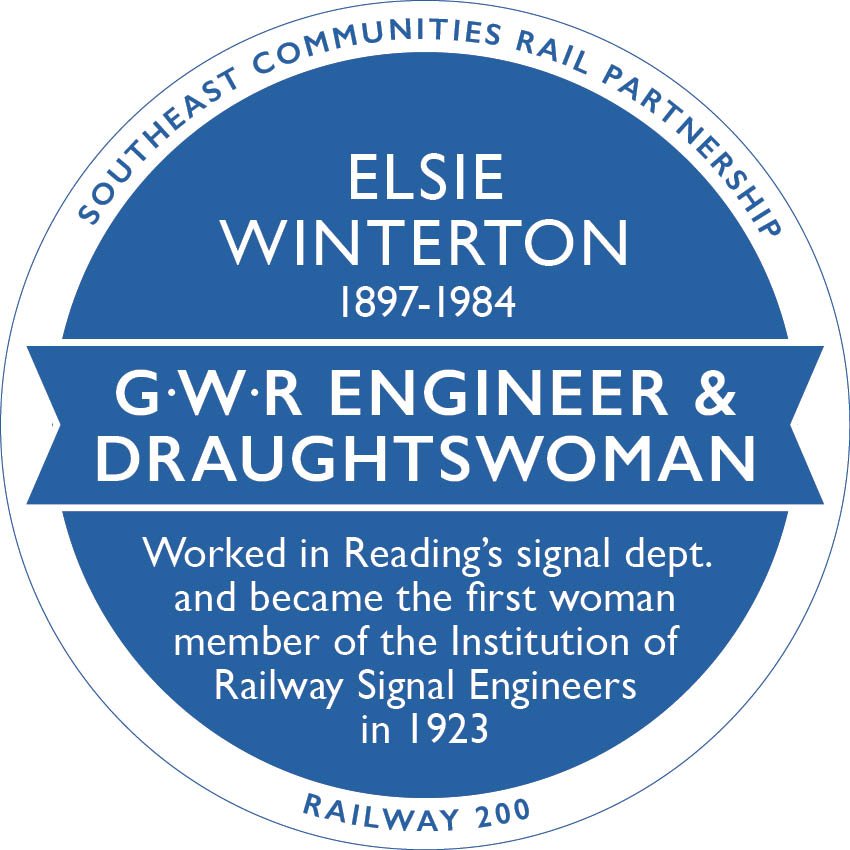
“At 24 Elsie was working as a tracer and draughtswoman in the GWR Signal Department in Reading, for example creating wiring diagrams of electronic railway signalling appliances”
-
Born in Reading in 1897, Elsie was one of nine children born to Rose and Joseph Winterton, a biscuit factory labourer for Huntley & Palmer. They were living at 112 Cumberland Road, Reading in the 1901, 1911 and 1921 censuses.
At 24 Elsie was working as a tracer and draughtswoman in the GWR Signal Department in Reading, for example creating wiring diagrams of electronic railway signalling appliances.
She became the first woman member of the UK’s Institution of Railway Signal Engineers (IRSE) in 1923” and “through her work at GWR and involvement with the IRSE, she met her husband, Edward Charles Deacon, and they were married in Caversham in 1930. As was usual at the time, she gave up her job to run the marital home but when her husband died in 1939, leaving her with two young children to support Elsie, Mrs. Deacon, rejoined the GWR Signal Department as a draughtswoman until her retirement in 1962, aged 65.
Elsie’s sister Ella Winterton passed the entrance exam and joined GWR in 1916 and also had a long career as a draughtswoman in Reading and later in Paddington. Another sister Doris joined GWR in 1929 and worked at Paddington station as a tracer’

“On Monday 29 February 1892 an express goods train carrying bricks, biscuits, corn, drainpipes etc, suffered an uncoupling as it descended the slope towards Chilworth. 35 of its 51 wagons derailed and many tumbled over the embankment, the guard’s van “was smashed to atoms” killing Henry the train guard”
-
Daughter-in-law of Henry Wicks. Jessie campaigned for a topiary tree in memory of Henry the railway guard killed by a goods train derailment near Chilworth in 1892.
Henry was born in Reading in 1839. By the time of his marriage in 1862 he was a railway guard. His bride was Emma Withers and they had three children Henry, Martha and Joseph. Living at 26 Cumberland Road in Reading.
On Monday 29 February 1892 a SER express goods train carrying bricks, biscuits, corn, drainpipes etc, suffered an uncoupling as it descended the slope towards Chilworth. 35 of its 51 wagons derailed and many tumbled over the embankment. According to the Berkshire Chronicle, the guard’s van “was smashed to atoms” killing Henry the guard on that train. The same paper reported that Henry “had been in the service of SER Company for upwards of thirty years... It was’t his turn to be on duty that night, he had voluntarily taken the place of another guard, who had gone to see his parents.”
His widow Emma stayed in the same house for some years before moving in with daughter Martha’s family and lived to the age of 88. Son Joseph, a gas and water engineer, married Jessie Williams in 1895 and moved to High Wycombe, they had a son Hubert.
It was Jessie who was instrumental in having the yew tree planted by the railway line, at the site of Henry’s death, as a memorial to her father-in-law. Clipped into the shape of a pheasant atop an armchair it’s known as ‘Jessie’s Seat’ or affectionately by some as ‘the Chilworth Chicken.’
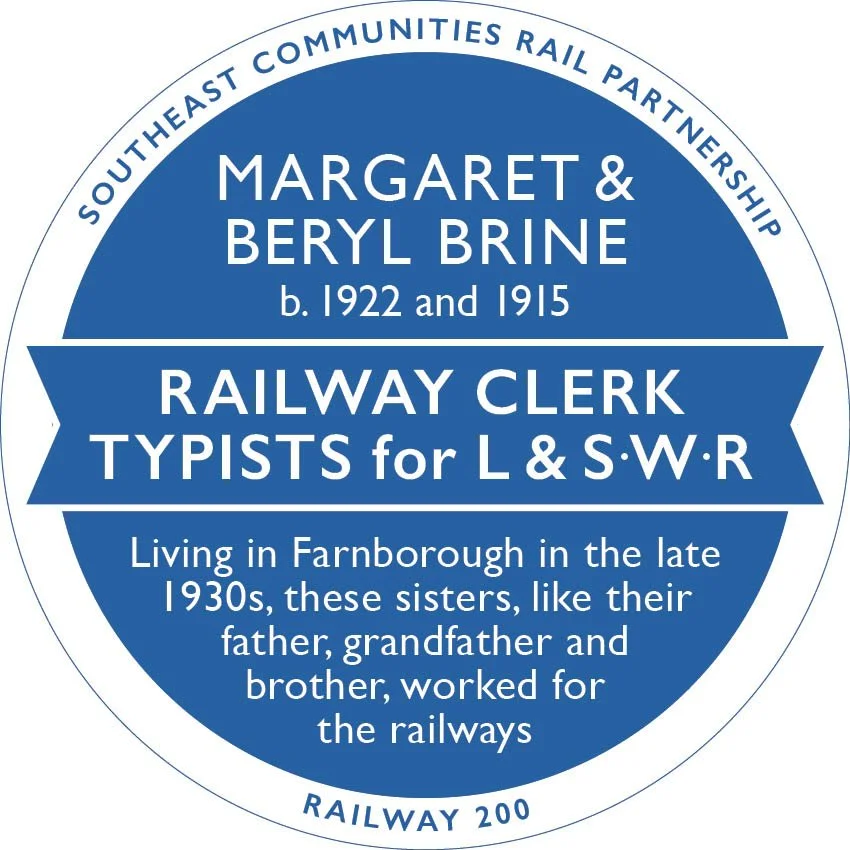
“Beryl bucked the railway trend and married a young farmer who had travelled to Canada a couple of times, on one occasion to the Agricultural Training School in Alberta. In 1946 Beryl took their two sons on the 14 day voyage to visit their father out there”
-
Margaret and Beryl’s paternal grandfather was a railway porter in Kingston-upon-Thames, and his son, their father Henry was at various times a railway messenger, an outdoor porter and goods clerk. Even their uncle Albert Brine was a railway parcels clerk, so a railway occupation would be hard to avoid.
The family were living in Cove by 1921, Beryl was 6, and she had two brothers, and Margaret arrived in 1922. In the 1939 identity card register both sisters were working as railway clerk typists and their father and brother were clerks too.
Margaret married railway clerk William Saitch, and had two children Janet and David. Beryl bucked the railway trend and married a young farmer, Liverpool-born Bernard Murtha, who had travelled to Canada a couple of times, on one occasion to the Agricultural Training School in Alberta, in the centre of Canada. In fact a couple of years after their marriage in 1946 Beryl took their two sons Bernard Jnr. and baby Peter on a 14 day voyage (each way) presumably to visit their father out there. The whole family did return to Surrey. Beryl and Bernard died just a year apart in 1981 and 82.
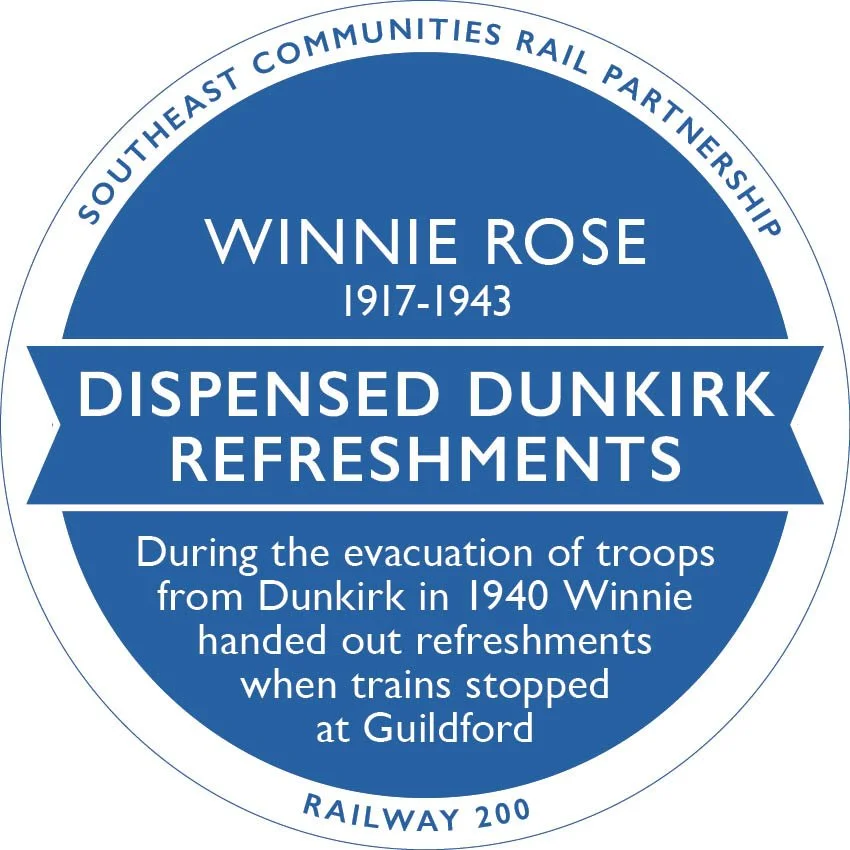
“She was among the volunteers who handed out food, drinks and cigarettes to the weary troops leaning out of their railway carriage windows and doors having been rescued from Dunkirk.
Tragically Winnie died in childbirth, aged 25”
-
Winnie was working in the buffet at Guildford railway station in May 1940 when trains conveying troops during the Dunkirk evacuation during the Second World War, stopped there.
She was among the volunteers who handed out food, drinks and cigarettes to the weary troops who were leaning out of their carriage windows and doors.
Known as Winnie, she was born in 1917, lived with her parents, sister and brother at 7 Falcon Road, Guildford. In 1939 she was doing laundry work and served in the Women’s Royal Naval Service (WRNS), at Hove in East Sussex, travelling exclusively by rail between there and home in Guildford.
In 1940 she married local boy Ronald Cranham, a builder’s labourer. Tragically she died aged 25 while giving birth to her son Ronald Jnr. who sadly didn’t survive either.
TONBRIDGE TO REIGATE LINE
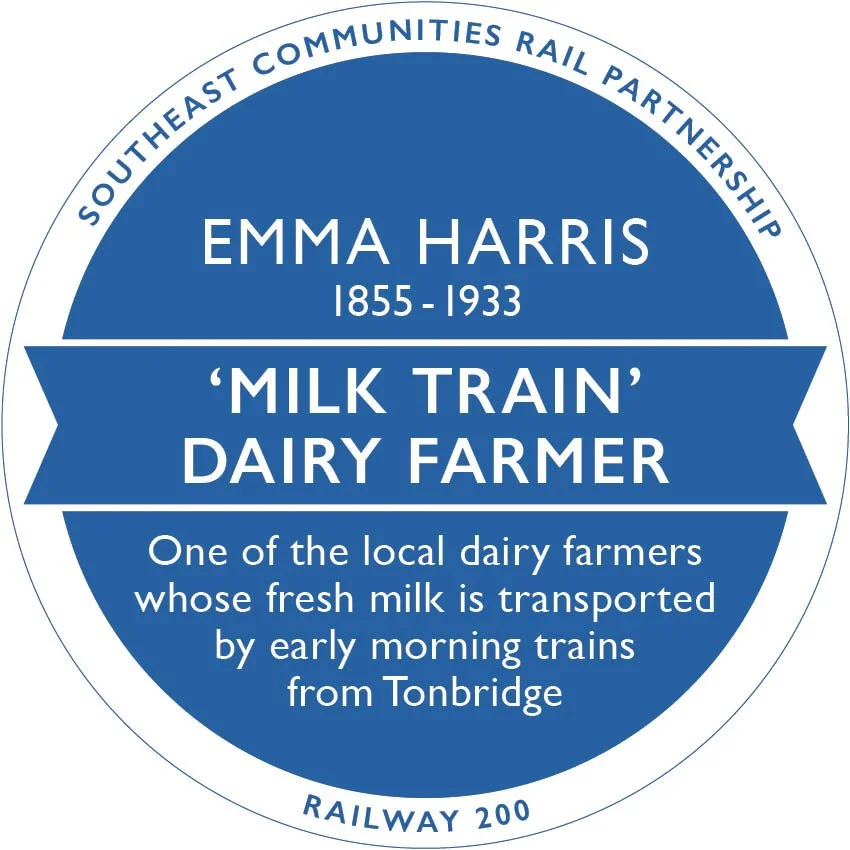
“In the 1920s milk from Emma’s dairy herds were being transported on morning trains from Tonbridge, 17 gallons (136 pints) of it daily. Nationwide some 282 million gallons of milk was being moved by rail in 1923”
-
The Roser family dairy farm was in Dry Hill, Tonbridge. It was run by Thomas and his third wife Hester.
Daughter Emma was born in 1855, one of four surviving children. When Thomas died in the 1870s Hester, now in her 60s, took on the farm herself - which in the 1880s totalled 70 acres, employing two men and three boys. They were living at 15 Shipbourne Road, Tonbridge (beside the George & Dragon pub).
A solicitor’s clerk called Ernest Harris - the son of a grocer on Tonbridge High Street - was lodging just a few doors away from the Rosers at No 4, and he and Emma were married. When Hester died in 1885, the farm’s value was to be divided equally between the children, so Emma and Ernest bought it themselves (which was contested in court!) By 1901 they had six children, who seem to have been given the middle name Roser. The sons became bank clerks and the youngest, daughter Ruby assisted her mother on the farm. In the 1920s milk from Emma’s dairy herds over in Ashurst were being transported on morning trains to Tonbridge, 17 gallons (136 pints) of it daily, and distributed by motor van.
According to one source 282 million gallons of milk was moved by rail in 1923, and this was gradually shifting to road.
Ernest died in 1924. Emma in 1933.
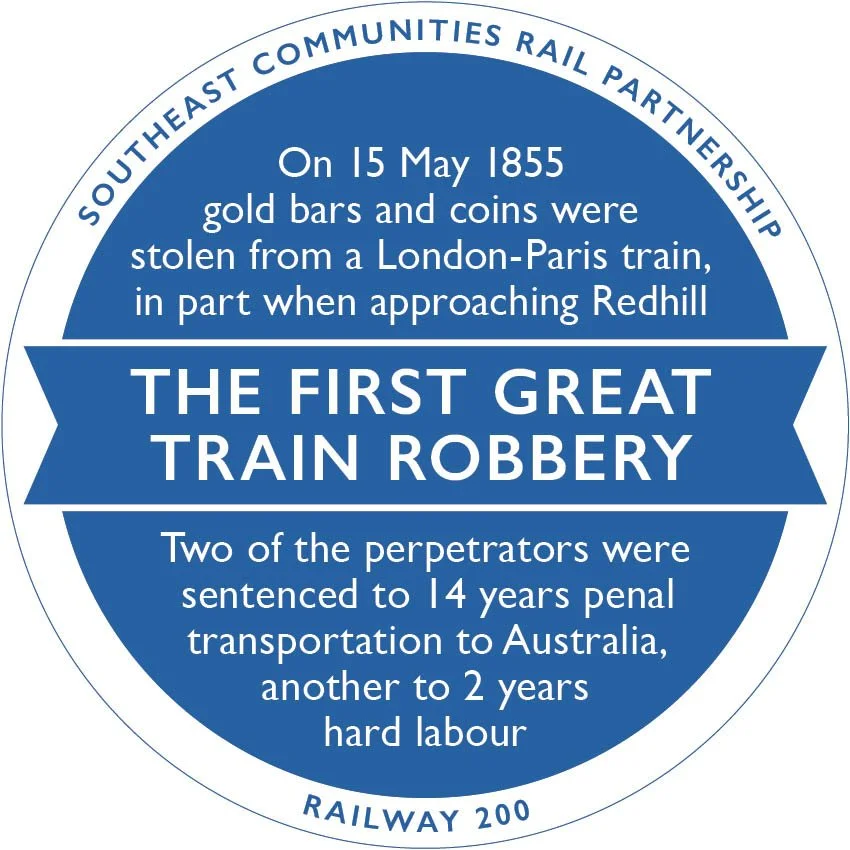
“The gold was said to be worth £12,000, just over £1m today in cash terms, but the value of gold itself has increased hugely from £4 an ounce to £2,400 an ounce since then, which might equate to over £7m today!”
-
On 15 May 1855 three locked, sealed and weighed consignments of gold bars and American coins - worth £12,000 - were sent in Chubb locked iron travelling safes by train from London to Paris. When they were opened it was discovered that bags of sporting shot had been substituted for the gold. A discrepancy in the weights of the safes along the route suggested it must have taken place on the South Eastern train somewhere between London and Folkestone. Hundreds of suspects were interviewed and many months of investigations passed yet the crime remained unsolved.
A man called Henry Agar had been convicted of cashing forged cheques in October 1855 and sentenced to be transported to Australia for life. From there he asked his friend William Pierce, who was holding a large sum on his behalf, to pass on some of that money to Miss Fanny Kay, a refreshment room attendant at Tonbridge railway station with whom he had a child. When it was clear William had kept the money for himself Fanny took her revenge. She reported her belief that Pierce was involved in the bullion robbery. Agar backed up Fanny’s claims with details of the crime. Implicating well-respected railwaymen James Burgess, guard of the van in which the safes travelled, and senior railway clerk William Tester, who arranged the roster of guards and knew the gold was on-board.
The travelling safes were provided by the railway company for such purposes, the keys being entrusted to the railway staff. After a fashion, wax impressions of the appropriate keys were made and counterfiet keys produced. When Tester knew a valuable gold consignment would be on board he assigned Burgess as guard and alerted Agar and Pierce to act. That evening, with first class tickets, Agar and Pierce boarded that train. They were in disguise and carrying heavy carpet bags (of lead shot) that the porter loaded into Burgess’s guard van. Under cover of darkness they moved into the guard van at a subsequent stop. The three men opened the safes, broke the wax seals and prised open the metal hooped boxes and switched the gold with approximately the same weight with lead shot from their bags. They replaced the metal hoops and created new wax seals. Tester was on board too, and at Redhill the first bags of gold were passed to him on the platform. Agar and Pierce bagged the remaining gold, tidied up, and changed carriages at a later station stop. At Folkestone they collected their carpet bags, spent the night in Dover and travelled back to London the next night where they met up with Tester. They melted down the gold in their backyard washhouse and a bedroom, forming small bars they could sell for gold sovereigns. These were exchanged at a bank for notes.
Agar, the self-appointed brains of the operation, was returned from Australia for the case to be tried at the Old Bailey in January 1857. He signed a confession and was kept in prison. Tester, who’d taken a railway job in Stockholm, was brought back to England where he, Burgess and Pierce all three pleaded not guilty. After all the evidence was heard the jury took just 10 minutes of deliberation to find them guilty of larceny. Burgess and Tester, being trusted railway employees, were given 14 years transportation for breaking that trust and Pierce, the lesser sentence of two years hard labour.
Having contracted tuberculosis Fanny took herself off to Hastings to recuperate, leaving her and Agar’s son Edward, and a trust fund, in the care of Pierce’s wife. But she died in Hastings in 1858, aged 27.
The gold was said to be worth £12,000, just over £1m today in cash terms, but the value of gold itself has increased hugely from £4 an ounce to £2,400 an ounce since then, which might equate to over £7m today!
Read historian Lorraine Sencicle’s encyclopedic account of the Great Bullion Robbery (in two parts) doverhistorian.com/great-bullion-robbery-part-i/

“Gunpowder was a moistened mixture of saltpetre, charcoal and sulphur and it’s rumoured that Guy Fawkes’ explosives came from an unauthorised maker in Battle. When the Leigh powdermill closed the Cheeseman family upped sticks to the Lake District, where Fanny’s husband became foreman of a gunpowder works there”
-
It’s rumoured that Guy Fawkes’ explosives came from an unauthorised maker in Battle. It wasn’t until the late 1600s that official powdermaking licenses were issued, the first to what is now Powdermill Lane, near Battle, with Tunbridge (as it was spelt then) following in 1813, in conjunction with Humphrey Davy and the Children family. Ingredients were a moistened mixture of saltpetre, charcoal and sulphur. This was then ground or ‘milled’ between large round, flat stones rather like a flour mill, powered by water, then compressed under heavy weights before processing into fine grained powder.
Inevitably accidental explosions occurred on site, killing workers, so it was a dangerous place to work. The powder was put into barrels and transported by road and river barges. In 1847 the GWR for example, concerned about moving explosives by rail (with the risks that steam engine sparks and fire posed) ordered that special ‘machines’ be used for transporting ‘gunpowder and combustible materials’ .
Fanny was born in Tonbridge in 1818 to Jane Morgan, a japaner (imitation black laquerwork) and Henry, a carpenter and millwright at the local powder mill. Fanny married Lancashire-born John Cheeseman in 1835 and by 1851 they were living next door to Fanny’s mum and dad. Fanny, John and the three eldest of their eight children (aged 11, 12 and 13!) worked as powder makers for Burton’s gunpowder company. Their advertisements read: “confidently recommended to all sportsmen as unrivalled, possessing great strength, cleanness, and promptness of ignition, and requires but a trial to prove its superiority.” These explosives were also very useful for railway building, for blasting chunks of rock and earth to form cuttings and tunnels.
After the death of Mr Burton, the Company and mill was sold. By 1861 the Cheeseman family had upped sticks to Kendal in the Lake District, where Fanny’s husband was foreman of the gunpowder works in Helsington, until the 1890s. They had made new lives in Kendal, both dying there towards the end of 1893. Fanny was 75, John was 83.
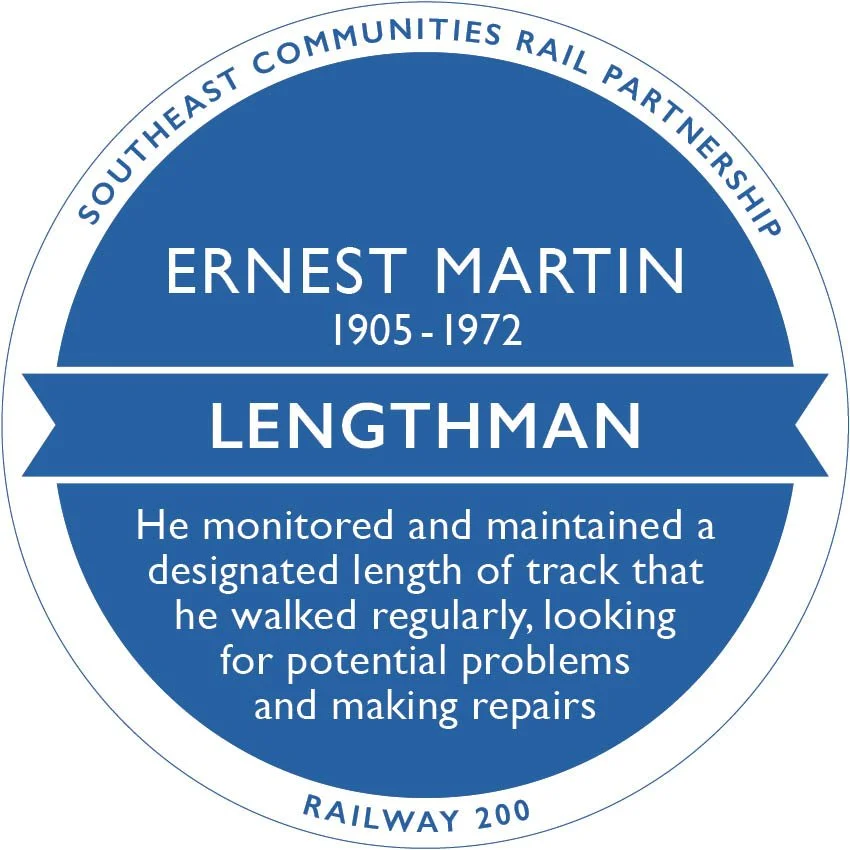
“To give you some idea of the distances a lengthman might walk: a retiring lengthman in Scotland in 1950 calculated that he’d walked 36,305 miles of track in a 17 year career!”
-
Born in Lewisham in 1905, Ernest Arthur George Martin’s father Arthur was from Chiddingstone, and was a platelayer and permanentway ganger on the Godstone Length for SE&C Railway. His mother Annie née Boakes was the daughter of a gunpowder factory carter in Leigh. They lived at 21 Lagham Road, Godstone (in 1921 and 1939 records) overlooking the railway line beside Godstone station. As a teenager, Ernest worked as a labourer at the local Terra Cotta brickworks before becoming a lengthman for South Eastern railways.
As a lengthman, or trackwalker, Ernest would regularly inspect his designated length of railway track,
to deal with minor problems and report more serious ones. He’d look out for any perishing of joints or loosening ‘keys’ he would tap back in, or signs of subsidence and clearing litter, weeds and obstructions. In the worst cases he’d get trains stopped until the problem was solved. Occasionally a lengthman would be injured or killed by passing trains.To give you some idea of the distances a lengthman might walk: a retiring lengthman in Scotland in 1950 calculated that he’d walked 36,305 miles of track in a 17 year career!
Ernest died in Horsham, in 1972, he was 67.

“It ‘leaked out’ that Horace “one of the best known employees at Hastings Station” was being forced to retire. He was 67 but “has never had any illness” and “judging by his present appearance he looks good for another twenty years.” A few months later he was being presented with a marble clock ‘From a few old friends’”
-
Horace was born at 5 Rock Cottages in Tonbridge in 1844. His father being a carman, a delivery man. By the age of 17 Horace had worked briefly as a butcher but had taken to portering. On New Year’s Day in 1865 he married Constance Munn Burr. They moved to Hastings quite soon afterwards and had at least six children, including twins William and Ann. They settle into 114 Stonefield Road, Hastings and in 1891 and 1901 Horace is describing himself as a railway luggage labeller. In 1910 however it ‘leaked out’ that Horace was being forced to retire, pensioned off. The local Observer newspaper described him as “one of the best known employees at Hastings Station” and a “faithful railway servant, labelling luggage for 45 years”. He was 67 by now but “has never had any illness” and “judging by his present appearance he looks good for another twenty years.” A few months later, in the station waiting room, Horace was being presented with a marble clock engraved with ‘From a few old friends’. He lost his wife Constance in 1918. He lived until 1928, to 84, almost the 20 years he’d been ‘good for.’
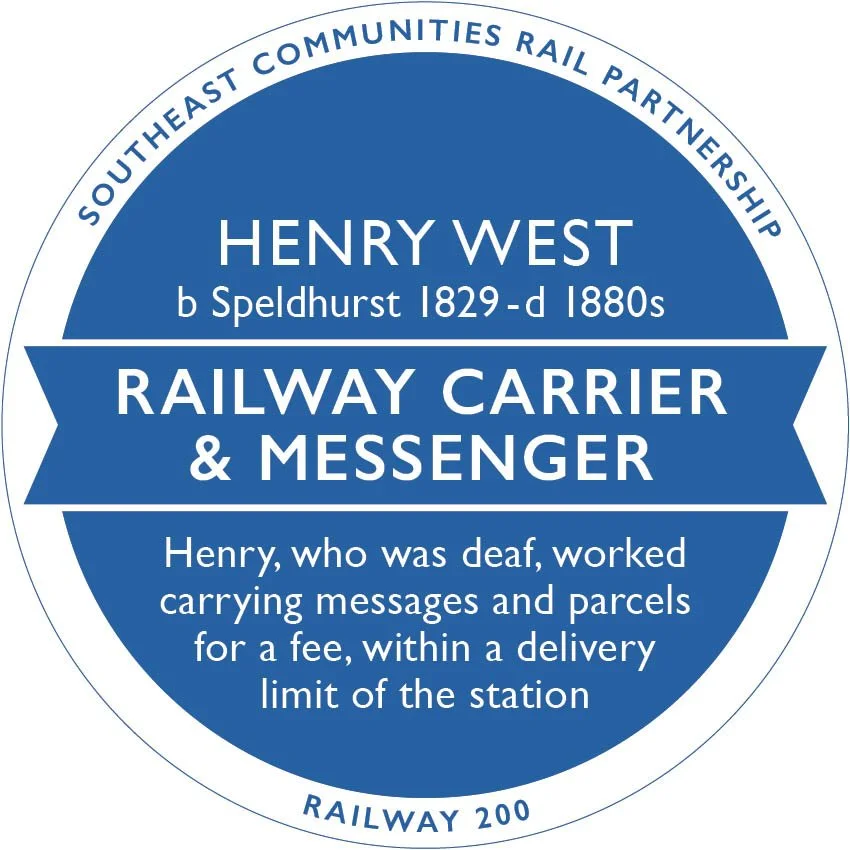
“On the 1881 census Henry, aged 52, was described as ‘deaf’. We’ll never know if this was recent or lifelong, caused by an accident or infection. It’s possible that being a messenger was a safer occupation to someone with hearing impairment, as opposed to working on railway lines for example where danger calls needed to be heard”
-
Henry West, son of Henry West, was born in Speldhurst west of Tonbridge in 1829 and as a boy, certainly of 12 and into his 20s was labouring on nearby Rusthall Farm. By 1861 Henry had found less strenuous employment as a railway messenger and was living at Station Cottage at Chiddingstone Causeway by Penshurst station with Harriet and their four children.
Like an ad hoc postman he would’ve charged a small fee per item, be it a note or package, usually within distance limits of the station. Perhaps to alert someone that a parcel, or even a visitor, had arrived at the station.
In the 1870s-80s the family had moved to The Square in Penshurst and had taken in lodgers, a saddler and two bricklayers. It was on the 1881 census that Henry, now 52, was described as having an infirmity, in his case ‘deaf’. We’ll never know if this was recent or lifelong, caused by an accident or infection. It’s possible that being a messenger was a safer occupation to someone with hearing impairment, as opposed to working on railway lines or powdermills for example where danger calls needed to be heard.
Henry died in 1880s and his widow Harriet, now in her 60s, continued Henry’s messenger and carrier services. She eventually moved to Beckenham to live with her widowed daughter Emily, where she died in 1908.
“Not unlike a cinema usherette, a platform girl sold refreshments direct to passengers while they waited for trains. The refreshment rooms would’ve been run by Spiers and Pond, an Australian catering firm funded the England cricket team’s 1861 tournament visit to Australia”
-
Born in Reigate in 1905, Isabel was one of six children of Amelia née White, a cane chair re-seater and Sampson Tarrant, a glass and china riveter - repairing and strengthening damaged items using metal staples.
Around 1921 Isabel was working at Redhill railway station as a platform girl. Not unlike a cinema usherette, this involved selling refreshments to passengers waiting for trains. The refreshment rooms would’ve been run by catering firm Spiers and Pond, who had 200 branches at their peak - as well as 12 hotels including Brighton’s Grand Hotel and the Gaiety and Criterion Theatre restaurants in London.
Spiers and Pond started in Australia in 1851, funding the England cricket team visit and play matches in Australia in 1861 (losing all but one match apparently). When they arrived in Britain in the 1860s, taking over station refreshment rooms, rather than paying rent they shared the profits with the railway companies. Their food was good quality at a fair price and so a great success.Isabel married stonemason William Green in 1926 and she would’ve given up her job. They moved to 56 Colesmead Road, Redhill overlooking the playing field and had two children, William Jnr. and Robert. During WWII William worked as an ARP gravedigger when called upon. Isabella lived until 1986.
“Two French navvies who took part in the riots were charged with making “a great noise, riot, and tumultuous disturbance, to the terror of Her Majesty’s subjects”. Passing sentence of a month’s imprisonment on the English perpetrators, the Judge cautioned that “any attempt to prevent aliens from honestly gaining their livelihood in this free country would be severely punished”
-
Born in Coleshill near Swindon in 1817, to Sarah and Stephen Stanbrook, a mason. Moses joined the Coldstream Guards at 18 but was invalided four years later with ‘diseased lungs’. He returned to Coleshill and began working as a stone mason like his father. Twenty years on he’s widowed and working again as a mason in London.
In his late 40s he lands the role of Inspector of Works at the railway building project at Tunbridge. In 1866 railway building contractors Messrs. Waring Brothers, running short of men on its Surrey and Sussex line at Cowden, began to bring in 500 extra navvies from France, Luxemburg and Belgium. There was growing disquiet that this foreign workforce were undercutting the English, potentially replacing them entirely - a fact publicly denied by the contractors. Conflicting evidence in the newspaper Court reports state on August 5 there was an altercation at a beershop, where the animosity drove a couple of Frenchmen to start a fight, windows were broken with bats, and two Englishmen were concussed. This prompted a group to ransack a farm housing French navvies, their wives and children. Fighting continued through Saturday night, all day Sunday and into Monday morning when, brandishing bludgeons the English herded the French to Edenbridge station where police were waiting. A further nighttime riot occurred where “the nightwatchman aroused The Inspector of Works Mr. Stanbrook” who discovered 40 or 50 men heading to the shanties from Markbeech. Stanbrook offered them “3 gallons of beer if you will go away quietly and not interfere with the foreigners” but to no avail. Collaring one of the men he was struck on the neck. Two French navvies were charged with unlawfully assembling and making “a great noise, riot, and tumultuous disturbance, to the terror of Her Majesty’s subjects”. Passing sentence of a month’s imprisonment on the English perpetrators, the Judge cautioned that: “any attempt to prevent aliens from honestly gaining their livelihood in this free country would be severely punished”. He concluded there was insufficient evidence to sustain a charge of rioting against the French men accused. But he complimented Mr Stanbrook “on the courage and sagacity he displayed in attempting to stop the riot.”
“As a railway engine timekeeper John would’ve recorded arrivals and departure times, hours worked, rest periods fulfilled, and generally making sure an engine crew were available to work”
-
John Charles Towes was the son of Martha and William Towes, a railway fireman and later engine driver. John was one of seven children born to them at 15 Garlands Road not far from Redhill Junction as it was called in 1871. In 1891, nine people living at No 15. John’s brothers William and Frederick worked as a stoker and engine shed labourer. John was 19 and was a railway engine timekeeper - arrivals and departure times, hours worked, rest periods fulfilled, and generally making sure an engine crew were available to work. A complicated task at a busy junction.
It’s hard to believe but local times across the country varied slightly from one end to the other. Train arrivals couldn’t always be predicted accurately, accidents were being caused and passengers might not make their expected connections. It wasn’t until the countrywide telegraph network made it possible for Greenwich to transmit a time signal ‘London Time’ for stationmasters to set their station clocks by. This began in 1847 but it wasn’t until August 1880 that an Act was passed that unified Great Britain’s standard time as GMT.
John’s wife Adelaide Entecott was a timber dealer’s daughter from Deptford who found herself in a poor school in Sutton before getting work as a parlour maid in Godstone in 1891. They were married in 1896.

“Sir Myles received a Chevalier of the Legion of Honour of France and Officer of the Order of Leopold of Belgium and he was the very first railway manager to receive a knighthood. He lived out his final years at Redstone Hall, overlooking an engine shed at Redhill junction. The hall was eventually demolished, and replaced by houses on what is now called Fenton Road”
-
Born in the Lake District town of Kendal in 1830 Myles’ mother Elizabeth was a postmistress.
Myles began his career, aged 15, on the Kendal and Windermere railway in 1845, criss-crossing the country for various railway companies in various capacities. In 1863 he became General Manager of the Metropolitan and in 1880 the Great Eastern Railway. His CV lists many high powered roles on boards and trusts. He received a Chevalier of the Legion of Honour of France and Officer of the Order of Leopold of Belgium and was the very first railway manager to receive a knighthood. He was made a Justice of the Peace, and Lieut. Col. of the Engineer and Railway Volunteer Staff Corps - whose objective was "the preparation, during peace, of schemes for drawing troops from distant parts and for concentrating them within given areas in the shortest possible time".In 1883, at the age of 53, he married the widow Charlotte Jane Collins and they moved to a rural country estate in South Nutfield, Surrey. He announced in the press that Nutfield’s new station would be opened for traffic on 1 January 1884. They eventually moved back into town, to Redstone Hall, overlooking an engine shed at Redhill junction.
He retired in 1906 aged 76, and died in 1918, aged 87. Redstone Hall was demolished in the 1930s and became Fenton Road.
MARSHLINK LINE

“In the First World War Verena helped build aircraft propellers, took technical evening classes, and apprenticed as a draughtsman. In 1919 she was a founding member of the Women in Engineering Society and completed an Engineering degree”
-
Verena was born in Ashford in 1889 to Florence and Edmond Holmes, an Inspector of Schools. In 1891 they were living at Highworth House, Ashford with five servants.
In the First World War Verena helped build aircraft propellors, took technical evening classes, and apprenticed as a draughtsman. In 1919 she was a founding member of the Women in Engineering Society and completed an Engineering degree. In the 1920s she worked for the North British Locomotive Co. becoming the first female member of the Institute of Mechanical Engineers and Society of Locomotion Engineers in 1944.Her inventions include the Holmes-Wingfield pneumothorax apparatus for treating patients with tuberculosis, a surgeon’s headlamp, a poppet valve for steam locomotives, and rotary valves for internal combustion engines. She advocated for employment opportunities for women in engineering.
Her birthday 23 June is International Women in Engineering Day, where the achievements of women in engineering are celebrated. Verena has a Class 375 Southeastern train and a faculty building at Canterbury Christ Church University named in her honour.
Institution of Mechanical Engineers imeche.org/verena-holmes

“The children’s mother became ill with cancer and died aged 41. Their father John and the two children worked on the model railway to occupy their minds through this distressing period. In 2016 Eddie, now Suzy Izzard, donated the family’s 00 gauge model to Bexhill Museum”
-
In the late 1950s and 60s John Izzard, an accountant for oil company BP, was working abroad in Aden (now Yemen) with his nurse wife Dorothy. Dorothy was expecting their first child so John began building a model railway. Their second child Edward was born in 1962 and the family moved first to Ireland and then Wales.
Dorothy became ill with cancer and John and the two children worked on the model to occupy their minds. She died in 1968 aged 41.It became a loving recreation of Bexhill including John’s old home Laburnum Cottages, an industrial unit and a model garage. And Sidley station, where John commuted from. A station that closed following the 1963 Beeching Report.
The model is 00 gauge or OO scale, 4mm to 1ft on 16.5mm track. Models and components were sold commercially eg as Hornby Dublo.
In 2016 Eddie, now Suzy, an internationally renowned actor and performer, donated the model to Bexhill Museum. In 2018, a few months after John Izzard’s death, a second model Suzy had commissioned was unveiled. This time an N gauge, 15ft by 7ft, based on wartime Bexhill in the winter snow.

“Many railworkers’ wives were employed as gatekeepers along the Marsh Line. In 1921, to name just a few, there were Florence Ransom at Bourman Crossing; Laura Fumiger at Ilbery Crossing; Agnes Beeching at Midley; Annie Gill at Church Lane Crossing, New Romney, and Alice Apps at Guldeford Crossing”
-
Sarah Durrant was born in Cranbrook in 1865. She married Alfred, a railway platelayer, in 1886 and they had six children. They lived for a time on Cyprus Place, Rye then in her 40s and 50s Sarah was the gate keeper at The Grove level crossing at the east end of Rye station from at least 1911-1921. This job came with a house by the crossing. This role, considered a light occupation sometimes offered to disabled railwaymen, was to open and close the gates to trains and road traffic and pedestrians in a safe and timely manner.
Many railworkers’ wives were employed as gatekeepers along the Marsh Line. In 1921, to name just a few, there were Florence Ransom at Bourman Crossing; Laura Fumiger at Ilbery Crossing; Agnes Beeching at Midley; Annie Gill at Church Lane Crossing, New Romney, and Alice Apps at Guldeford Crossing.
After a long career as a platelayer Sarah’s husband retired and they moved to 15 Udimore Road, Rye to live with their married daughter Ethel, her husband Percy, and their two children. Sarah died in 1950, aged 84.
“Molly Hullis and her 17 year old boyfriend Robin, a singer in the pop group The Bee Gees, had been to visit her parents in Hastings. On the Sunday evening of 5 November 1967 they were travelling alone in First Class on the otherwise busy 7.43pm train to Charing Cross. The track was fractured at Hither Green causing the train to derail, killing 49”
-
Robin Gibb, the 17 year old singer in the pop group The Bee Gees, and his girlfriend Molly Hullis, had been to visit her parents in Hastings. On the Sunday evening of 5 November 1967 they were on the busy 7.43pm train from Hastings to Charing Cross. As it passed through Hither Green in driving rain at 70mph (below the 90mph limit) the track fractured and the train derailed. Only two of the 12 carriages remained on the track. 49 people died and 79 were injured. Robin and Molly, who were alone in a First Class compartment, were lucky to escape with cuts and bruises.
Robin (and his twin Maurice) were born on the Isle of Man just before Christmas in 1949. With their older brother Barry they started a short-lived band. When the family moved to Australia in the late 1950s they changed their band name to the Bee Gees. And with some success they returned to the UK in 1967.
So began a hugely successful career for the brothers that would span 50 years and 22 studio album. They were one of the best-selling music acts of all time.

“The role of a tracer was highly skilled, but perceived to be less technical than the draughtsmen’s work. However, since it was the tracers that produced the master copies, the majority of the drawings that survive were penned by women”
-
Maud Mary Bassington was born in Kensington in 1895 on what is now Hillgate Place, Notting Hill Gate. Her father William was a basket maker, who sadly died in 1902 when Maud was just 7 years old. Her mother Frances remarried in 1905, but her new husband Alfred Hawkings soon died. By 1911 Maud and her mother were living in Willesden where Maud was working as an artist, a floral painter.
In 1921, after the First World War, and possibly during the war we don’t know, Maud was putting her drawing skills to technical use as a tracer at the SE&C Railway Loco Drawing Office at Ashford works, aged 25. According to Chris Valkoinen of the National Railway Museum “The role of a tracer was highly skilled, but perceived to be less technical than the draughtsmen’s work. Just as secretarial work became a female dominated profession due to misogynistic attitudes, women also began to be employed as tracers, a process that was accelerated by the First World War. However, since it was the tracers that produced the master- copies that were retained by the drawing offices, it is worth remembering that the majority of the drawings that now survive in the museum’s collections were penned by women and not men.”
It is at the Ashford Works that she likely meets 53 year old widower Christopher Kybert, an accountant in the locomotive department there, 27 years her senior. They marry in 1921 and had a daughter Christine in 1931. Christopher died in 1938, aged 70. Maud died in 1968.
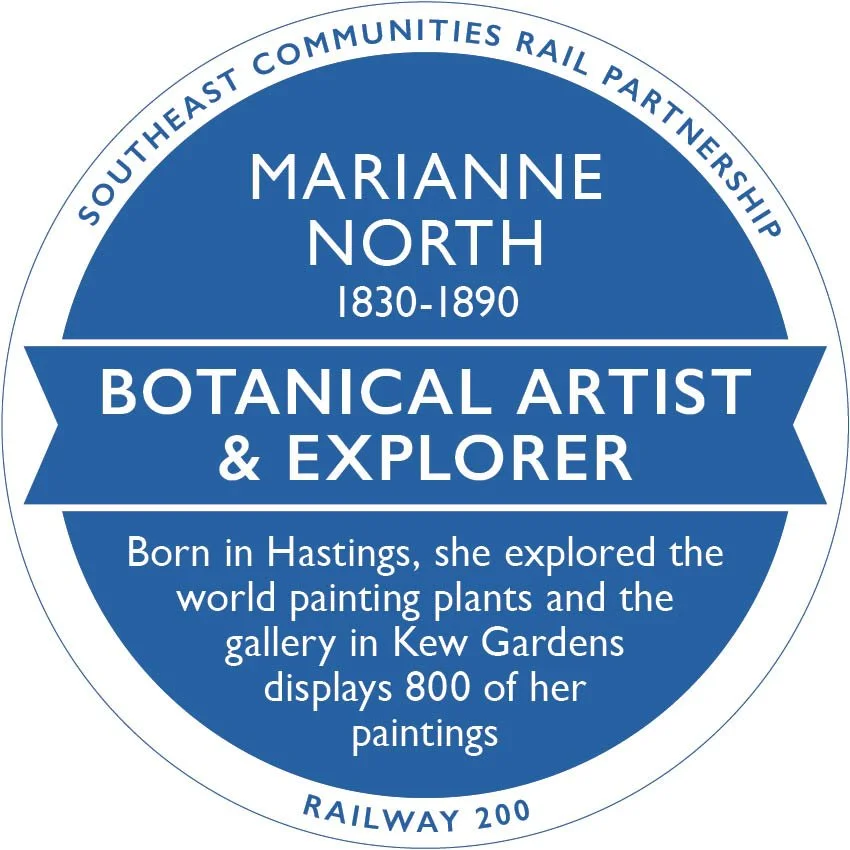
“It was while waiting for a train in 1879 that she decided to write to her friend Joseph Hooker, the Director of Royal Botanic Gardens, Kew, to propose the idea of building a gallery there, at her own expense, to display her work. She did, and he said yes.
Her last trip was to be to Chile where she was advised that her hunt for the Monkey Puzzle tree may be futile as they were being cut down for railway sleepers”
-
Born into a prosperous family in Hastings in 1830, the eldest of three. Her parents were Janet Marjoriebanks and Frederick North, MP for Hastings and Justice of the Peace. She took up singing and later had painting lessons in watercolour and oils. Painting was an acceptably genteel occupation for a middle-class young woman.
After the death of her mother, and after her father lost his seat in parliament Marianne travelled a great deal with him, fulfilling one of her mother’s wishes. “My father often took me on expeditions, starting by rail, and then plunging into the forests, over hills and valleys” she wrote. He was taken ill on a trip to Switzerland so they returned home. He died soon after. Marianne was not yet 40, and without other ties she decided to devote herself to exploring the world and to paint portraits of the plants she encountered.
In the 1870s she visited North America, Brazil, Japan, Borneo and travelled around India on an unlimited rail pass and painted a distant Mount Everest. On the suggestion of Charles Darwin she then travelled to Australia and New Zealand.
According to her letters, it was while waiting for a train at Shrewsbury station in August 1879 that she decided to write to her friend Joseph Hooker, the Director of Royal Botanic Gardens, Kew, to propose the idea of building a gallery there, at her own expense, to display her work. She did, and he said yes. It opened in 1882. And to this day still displays over 800 of her paintings.
Her last trip was to be to Chile where she was advised that her hunt for the Monkey Puzzle tree may be futile as they were being cut down for railway sleepers. Thankfully the runour was unfounded. Marianne retired from travelling at 55 to a cottage in Gloucestershire where she died aged 59.

“In the 1851 census 400 people in the Hastings area, 100 of them in Ore parish, described themselves as ‘rail labourer’ - no-one identified as a ‘navvy’”
-
A railway line from Hastings-Rye-Ashford had a troubled beginning, with different railway companies vying for supremacy in the 1840s. Work began at the Ashford end and it wasn’t until 1850 that the Lord Mayor of London was invited to insert the last brick in both the Ore and Mount Pleasant tunnels at the Hastings end of the line.
In the 1851 census 400 people in the Hastings area, 100 of them in Ore parish, were described themselves as ‘rail labourer’ (no-one identified as a ‘navvy’).
Labourers often brought their families along, and were in lodgings, several families were living in huts in fields and at Lady’s Parlour along Cackle Street, Ore, what is now Frederick Road, and Deepdene Gardens. One such family were the Austens. George had been an agricultural labourer in Benenden, but when the opportunity for labouring work on the railways came along he took it. He moved his wife Ann and two sons, James an errand boy and George Jnr, who followed in his dad’s footsteps as a teenager.
The line opened eventually in 1851 after a court case involving two railway companies, who finally agreed to share facilities, though the line wasn’t technically finished until 1870.
It wasn’t until Ore village expanded that a station was considered and finally opened in 1888.
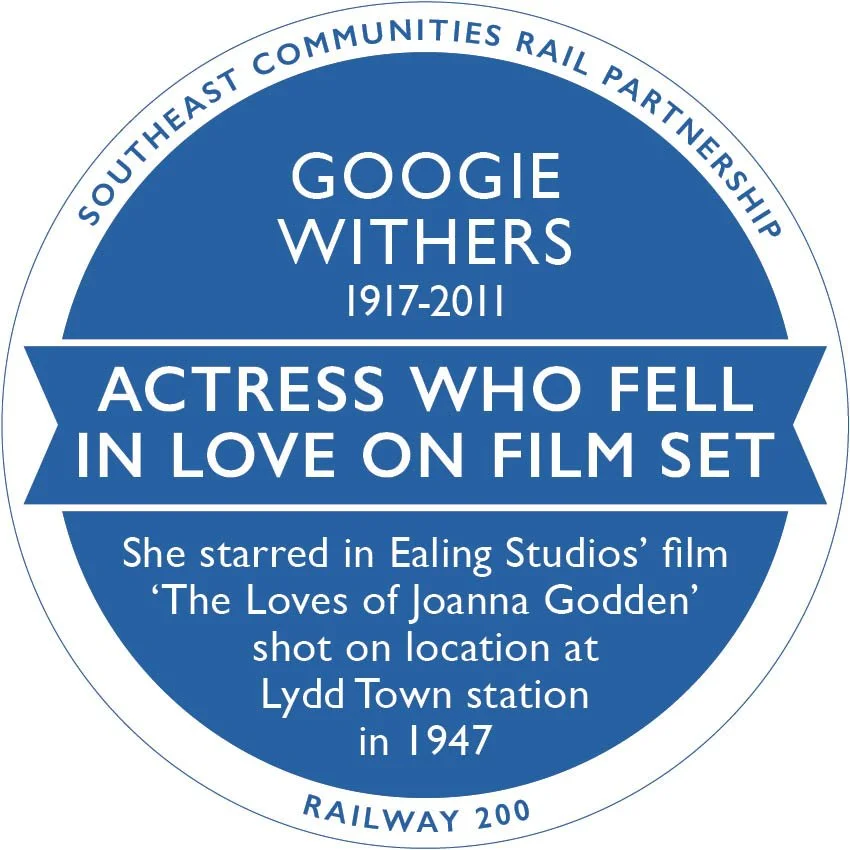
“Googie fell in love on set with her co-star, Australian actor John McCallum. They married and had a daughter named Joanna, like the film’s heroine”
-
Scenes from Ealing Studios’ 1947 film The Loves of Joanna Godden were shot on the New Romney branch line from Appledore at Lydd Town railway station, at the Woolpack pub and on Romney Marshes. The fictional station was called Brodnyx.
The Kent & East Sussex Light Railway nearby lent a Class A1X ‘Terrier’ locomotive for the filming. The engine and carriages having been branded ‘South Eastern & Chatham Railway’.
It starred Googie Withers, a dancer and actress, well-known in British films in the 1930s and 40s. In The Loves of Joanna Godden she played the title role of Joanna, a woman who inherits her father’s sheep farm and defying convention sets about running it herself.
Googie fell in love with and married her co-star, Australian actor John McCallum, and they had a daughter they named ‘Joanna’. Georgette, or Googie, Withers was born in Pakistan in 1917 (her dad was in the Royal Navy). She died in Sydney, Australia 2011, aged 94.

“Mr Impett, the manager of the railway, arranged a hair-raising journey between Oraya and Lima by gravity on an unpowered track-trolley with only a handbrake to control speed on the 1 in 33 gradient falling 11,800 ft over 106 miles!”
-
From the Ashford People’s Library Project: 180 Years of Railway History
“John James Impett, son of an Engine Fitter, Newtown school boy and SER apprentice went on to become a member of the prestigious Institution of Civil Engineers, enjoying an illustrious career in Brazil and Peru. Recruited as an office lad, he later transferred into the workshops as a fitter’s apprentice. In 1884 he appears in records as an engineer on the Paulista Railroad, in Sao Paulo, Brazil, a move which transformed his career, the terrain testing his engineering capabilities. John briefly returned to England in 1889, before travelling to Panama on route to Peru, where he became engineer on the Central Railway of Peru. In a book entitled ‘Forty Years On’ by Lord Ernest Hamilton the author describes meeting Mr Impett, then the manager of the Oraya railway, who arranges a hair-raising journey between Oraya and Lima by gravity on an unpowered track-trolley with only a handbrake to control speed on the 1 in 33
gradient falling 11,800 ft over 106 miles!
In his 1901 application to join The Institution of Civil. Engineers James states his place of education as the SER’s school and evening classes. He died in 1901 in a house called La Quinta [Oxenturn Road] in Wye [in Kent].”

“Elsie’s husband, a railway clerk called Horace, was relocated during WWII to the emergency Southern Railway headquarters in a former hotel in Dorking. The building housed an all-male crew of clerks, messengers, surveyors, police officers and its own chef, kitchen porters and waiting staff.”
-
Elsie and Lynda were two of the seven children born to Melynda and Charles King, a gas stoker. The family were living in Rye.
By 1921, Lynda now 24 and Elsie, 22, were getting the train from Rye to the railway works in Ashford where they were both shorthand typists for South Eastern & Chatham Railway.
In 1926 Lynda married Peter Caven a SE&CR railway shipping clerk, and in 1929 Elsie married Ashford Works railway clerk Horace Winder. Horace was relocated during WWII to the emergency Southern Railway HQ in a former hotel in Deepdene in Dorking. The building housed an all-male crew of clerks, messengers, surveryors, police officers and its own chef, kitchen porters and waiting staff.Lynda moved to Dover with Peter and their two children during the war. She lived to 64. Elsie was living in Dorking when she died in 1982, aged 83.
HOUNSLOW TO RICHMOND LINE

“Alfred’s impressive CV included the redesign and rebuilding of bridges to increase their load-bearing capacity and Feltham’s gravitational shunting yard - where ‘Tom’ Bristow worked”
-
Born in Milford Haven, Pembrokeshire in 1858, the fourth son of Polish tailor Albert Szlumper, Alfred and his brothers James and William were destined to become successful engineers.
From 1880 Alfred became engineering assistant on the South Eastern and Chatham, then the Great Indian Peninsula Railway based out in India, then the London and South-Western Railway Company, first as assistant then in charge of projects for 12 years.
He rose to Divisional Engineer and in 1914 Chief Engineer. He held this role until his retirement in 1927.
Alfred and his wife Fannie were living in Putney c1901-1911. They had a daughter Frances and son Gilbert, a civil engineer, who travelled around the world as Docks and Marine manager of L&SW Railway in Southampton before rising to Southern Railway General Manager, a Major General and a CBE.
Alfred’s impressive CV included the redesign and rebuilding of bridges to increase their strength and load-bearing capacity at Barnes, Richmond, and Kingston; the gravitational shunting yard at Feltham, not to mention completion of the reconstruction of Waterloo Station 1914-15. During the war his skills served both the War Office and the Admiralty, becoming President of the Permanent Way Institution and a valuable member of the Institution of Civil Engineers. Although he retired in 1927 he remained happy to be consulted on railway projects. He died at his home in Sheen Common Drive, North Sheen in 1934, aged 76.

“In 1925 Tom married Elsie Madeline Gould, the daughter of a Kent road contractor”
-
‘Tom’ was born in Wateringbury near Maidstone in 1900 to Bertha Bristow and her husband Thomas, a brewer’s labourer.
By the age of 20 Tom was working as an engine cleaner for South Eastern Railway. In Dartford in 1925 he married the daughter of a Kent road contractor, her name was Elsie Madeline Gould, and by 1939 they’d had a child, possibly Thelma, and were living on Cassiobury Avenue in Feltham. Tom was working as a locomotive fireman and later in Feltham marshalling yard. He died in 1953, he was 53.
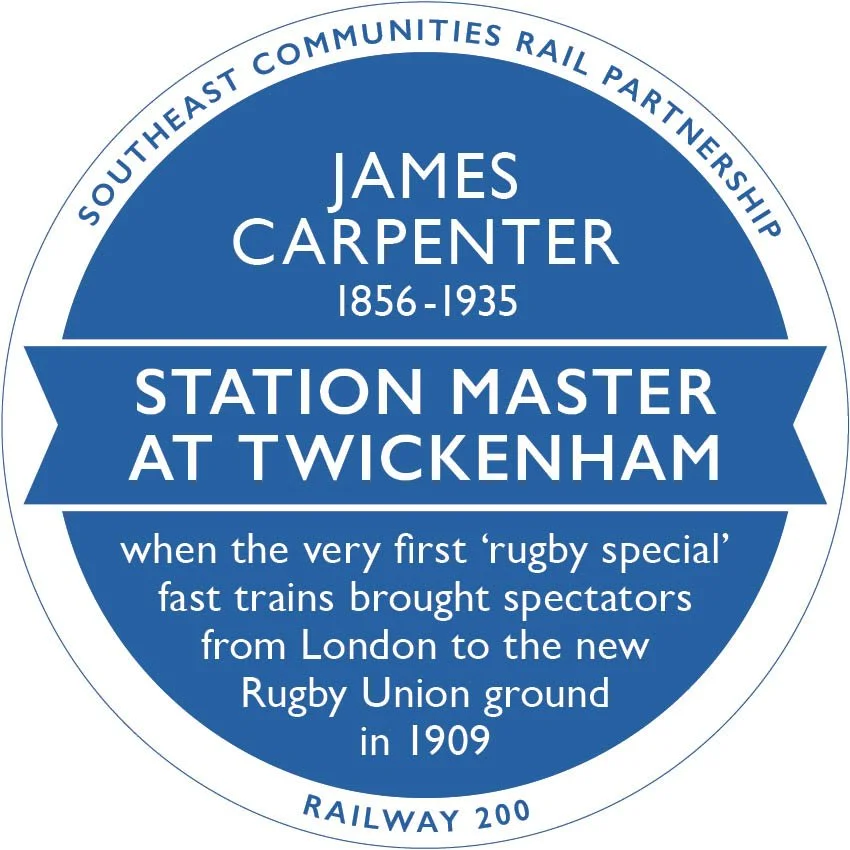
“Following the inaugural match in 1909, a newspaper wrote ‘Twickenham is possessed of an obsolete station with pettifogging approaches and exits, and we are inclined to regard the transhipment of a score of thousand people in a few hours without mishap as a triumph of luck’”
-
The first Twickenham railway station opened in 1848, with two platforms around a double track and a Gothic-style brick station building. James Carpenter was the station master here in 1909 when the majority of the 3,000 spectators passed through the station to watch the inaugural match at the new Rugby Union ground nearby.
James was the son of a gardener, born in Froyle near Alton in 1856. He started his working life as a railway clerk and by his 30s he was station master at Medstead, then at Farnborough and later to Twickenham.
The Rugby Football Union bought 10 acres of vegetable gardens at Twickenham in 1907. The first stands and roads were built and by 1909 the stadium was ready for its first match Harlequins v. Richmond on Saturday 2 October. With a capacity of 9,000 seated undercover and a similar number standing a great many spectators were anticipated.
The London and South-Western Railway Co. had announced a special fast train departing Waterloo North for Twickenham in 22 minutes, with return post-match special services too.
Harlequins defeated Richmond 14 points to 10. And in post-match analysis the newspapers were complimentary about the excellent dressing accommodation but critical of the Press facilities, and of the condition of the ‘pitch’ saying the grass was too long, the going was heavy after rain, and players were being tripped up by awkward turf.
One newspaper remarked that “Twickenham is possessed of an obsolete station with pettifogging approaches and exits, and we are inclined to regard the transhipment of a score of thousand people in a few hours without mishap as a triumph of luck. The winding steps and bottle- necked approaches have been described as death-traps.” Another complained “the ground cannot be considered as cheap and easy of access from London”.
New platforms were built in 1938, with the station being completely rebuilt in 1954. The station was drastically overhauled, at the Rugby Football Union’s behest, to help improve the handling of spectators. It opened in 2020 as Twickenham Gateway.

“Albert married Florence Switzer, the daughter of a heraldic artist, living on the Isle of Wight”
-
Born in Petersfield in 1876, Albert married Florence née Switzer in 1900, she was the daughter of a heraldic artist. At the time she and her family were living on the Isle of Wight.
The couple moved to Edgell Road, Staines and in the 1911, 1921 and 1939 censuses they were living on Hounslow Gardens, Whitton Road in Hounslow. They had three sons Albert and Walter (who worked as railway messengers as teenagers) and youngest Gordon.
Though father Bert was technically a guard he was once called upon to drive a train from Waterloo to Hounslow. One of their children Sidney became a signalman and guard.
Albert died in 1971, aged 95.

“On 13 Feb 1936 Charles and William saved Alec and Joyce, aged 6 and 8, from drowning then hurrying back to their train to continue their journey in wet clothes.”
-
On 13 Feb 1936, upon hearing children’s cries for help, engine driver William Long and fireman Charles Wallace stopped their Southern Railway goods train near Pooley Green level crossing in Egham. They leapt out to rescue two children, Alec and Joyce Taylor aged 6 and 8, who were ‘struggling for life’ in a partly frozen pond. ‘They jumped into the water, pulled out the children, restored them to consciousness, and sent them home. Then hurrying back to their train continued their journey to Feltham’ in their wet clothes.
William was born in 1891. He and his wife Caroline were living on Meadow Road, Hounslow in 1939 with daughters Maureen and Sylvia.
Charles was the son of a dockyard blacksmith, born near Ebbsfleet in Kent in 1902. He was a railway fireman by the age of 18, marrying Edith Burgess in Faversham in 1924 and they had three or four children there. They were living on Southern Avenue, Feltham by 1939. Charles retired in 1967 after 50 Years service. He died in 1976.
The saved children Alec and Joyce, belonged to Harriet and Frederick Taylor, a milkman who lived Vicarage Road, Egham. We don’t know what became of Alec but we think that Joyce grew up to marry a chap called Kenneth Stradling and may have had a daughter called Angela.

“The orphanage Graham fundraised for was on Oriental Road, Woking, and was home to about 120 children whose railway worker fathers had been injured or killed”
-
The North Downs’ Line have a Railway 200 blue plaque in honour of Maria Core, the Matron of the Railway Servant’s Orphanage on Oriental Road, Woking. It was home to about 120 children whose railway worker fathers had been injured or killed. Railway fireman and shunter Graham Perrin raised money for the Home by selling Locomotive pin badges in his spare time.
He was born in 1941 and married Jean in 1964. Their daughter Michelle tells us that the family lived in the railway houses on Waterloo Crescent and Southern Avenue for many years. He was a fireman as a teenager, at first on steam engines, and when they were taken out of circulation he went to Feltham as a shunter. Later he worked at the station itself for many years.”
Feltham resident Matthew Savage remembers “those locomotive pin badges being sold to raise money for the Children’s Home at a kiosk just besides the ticket barrier at the top of the platform bridge”.Graham died in 2009, he was 67.

“The Richmond Railway Co. complained that landowners in Barnes were particularly resistant to selling. Those with grazing rights on Barnes Common refused immediate possession”
-
In the early days of railway construction the private Railway Companies had to negotiate the purchase of land from hundreds of individual landowners along a prospective route. From 1825 Parliament debated each new Railway Company proposal for reasoning, impact and viability.
The passing of the Richmond (Surrey) Railway Act 1845 meant the Company was “authorized and empowered to enter into and upon the Lands and Grounds of any Person or Persons.... for making, preserving, improving, completing, maintaining, and using the said Railway”. The Lands Clauses Consolidation Act, 1845 helped standardise the rules of best practice and covered many points including compensation schemes; the landowner’s right to object; adherence to approved plans; to repair roads damaged or otherwise interfered with; Companies not entitled to minerals found on the land unless expressly purchased; making good on completion and relevant penalties for not adhering to the law.
Some landowners and tenants accepted token sums, the wealthier landowners had the clout to get the best price or afford to fight in the courts to refuse to sell. Tenants may have to give up an arable crop for example or lose access to grazing land for their livestock. Market gardeners such as James Priseman would be granted compensation.
The Richmond Railway Co. complained that landowners in Barnes were particularly resistant. The line would need to pass through Barnes Common which was the property of St Paul’s Cathedral, and Barnes Commoners with grazing rights on that land, refused immediate possession. According to Leslie Freeman’s research Henry Higgs, a tenant on a Mrs Chapman’s land accepted £215 compensation, while Mrs Chapman herself refused an offer of £1,000, demanding the company either take the entire field or build a bridge over it! She finally settled five months later on £1,443 8s 8d (£150,000 today).
James accepted £40 (£4,200 today) for his crops and interest in the land. He and his wife Frances left Barnes for central London where he took work as a clerk, a grocer, a shopman before returning to gardening in the 1870s.

“A scuffle broke out with a 20 year old passenger without a ticket. John was injured and suffered a coronary thrombosis as a result and died. He was 52”
-
John was one of possibly six children to Mary née Hall and William Budd, a Southern Electric railway motorman. The family lived on Kings Farm Avenue beside North Sheen station.
John’s two brothers were engine cleaners, and both qualified as drivers, and John was a drycleaner’s errand boy before taking to the railways himself from the age of 16. As a married man he was living on Feltham High Street.
On Friday 30 January 1976, while on duty checking tickets on the platform at Norbiton station, an argument and scuffle broke out with a 20 year old passenger without a ticket. John was injured and sadly suffered a coronary thrombosis as a result and died. He was 52. A Southern Region spokesman said “He was a very conscientious employee, and had proved himself a loyal servant of the industry.’ While his funeral took place at Hanworth Crematorium some train services in the area were poignantly halted for 15 minutes as a mark of respect.

“Sidney was working as railway messenger at 18, with his brother Walter who was just 14”
-
Sidney King was born in Staines in 1902, to Florence and Albert a railway signalman and later a guard (mentioned above).
In the 1911, 1921 and 1939 censuses the family were living on Hounslow Gardens, Whitton Road, Hounslow.
In 1921 Sidney was working as railway messenger, at 18, with his brother Walter, just 14, for London South Western Railway. Lillian Powell became his wife in 1930 and by 1939 Sidney was a signalman and they were living on The Drive, Feltham with their daughter Audrey.During World War II Sidney operated the signal box at North Sheen. He died in Feltham in 1978.

“Thomas followed in his brother, his father, his grandfather and great step-grandfather’s footsteps to become an engine driver. He grew up in the maisonettes on Waterloo Crescent in Feltham, as so many railway families did”
-
The son of Florence Catling and Thomas Percival, a L&SW railway fireman, Thomas Jnr. followed in his brother, his father, his grandfather and great step-grandfather’s footsteps to become an engine driver.
He grew up in the maisonettes on Waterloo Crescent in Feltham, as so many railway families did, and by 19 he described himself in the 1939 identity card register as being a Southern Railways engine cleaner but ‘qualified to act as a fireman’.
Feltham was a prime target for German bombing raids during WWII as it housed the Central Vehicle Depot and Central Ordnance Depot where munitions were stored prior to distribution. Thomas recalled how during the war they ferried ammunition on trains to the south coast. Munitions factories worked round the clock to produce weapons and ammunition and relied on the railways to transport industrial quantities long distances.
Additional supplies arrived at the ports from the USA which needed to be transported south by rail too. Such cargo was extremely dangerous, so the primers and detonators were always carried separately under fire-retardent tarpaulins that covered the wagons in order to prevent stray sparks flying in from the coalfired engine.
Occasionally terrible accidents did occur. A wagon of munitions caught fire near Soham, Cambridgeshire in 1944. Four selfless, brave railwaymen on duty quickly uncoupled the affected wagon which was attached to the engine, and moved it off away from the rest of the deadly cargo before it exploded. Explode it did, killing the fireman Jim Nightall and ‘Sailor’ Bridges in the signal box. Driver Ben Gimbert was thrown clear. Herbert Clarke the guard, at the rear of the train, was thrown 80ft but made his way two miles back along the track to lay warnings for oncoming trains. Gimbert and Nightall were both awarded the George Cross for their courage.
SUSSEX DOWNS LINE

“Sightings included him getting out at Henfield to be given a biscuit at a public house. As he grew older, and more confident, he travelled further afield, disappearing for up to a month at a time. On one or two occasions he made it as far as Glasgow!”
-
A fox terrier and beagle cross named Jack was born in Lewes Station in March 1878 to station master Mr Moore. He went missing as a 4 month old pup but was discovered at Eastbourne a fortnight later where he’d made himself at home.
Brought back to Lewes he was soon away again on a train to Brighton. Making the most of the London Brighton & South Coast railway line, without a ticket, generally sitting by the train driver or guard looking out of the window. Moving between Horsham, Brighton and Eastbourne for example, he always seemed to be back at Lewes Station for bedtime.
Sightings included him getting out at Henfield to be given a biscuit at a public house, then onto a later train to West Grinstead for the afternoon before returning to Brighton for the last train to Lewes. As he grew older, and more confident, he travelled further afield, disappearing for up to a month at a time. On one or two occasions he made it as far as Glasgow! and a diary was kept by the guards and other railway workers of his whereabouts.
He became so well-known the railway company presented him with a collar inscribed with ‘Jack, London, B and S. Coast Railway Company’, one of three collars he received.
In 1880 he was found in Polegate with an injured leg which was subsequently amputated. But so famous was he that in 1883 three-legged Jack was presented to the Prince and Princess of Wales in Eastbourne by Lady Brassey, the wife of the railway magnate.
Jack died at the home of his master Mr Moore in November 1890. He was nearly 13.
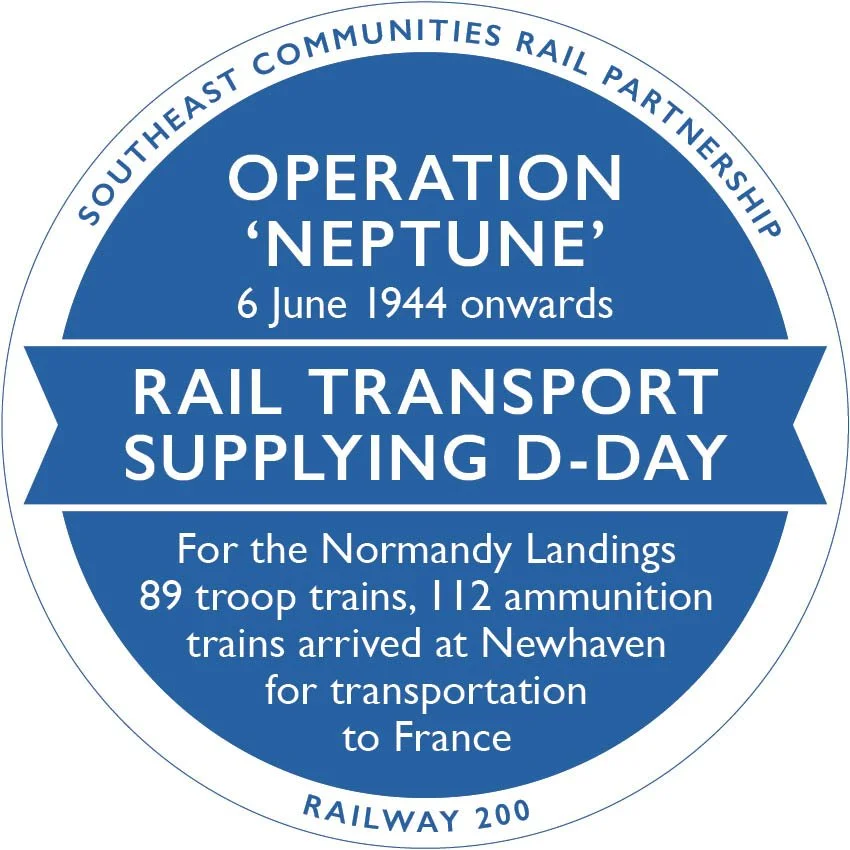
“Railway employees in the Newhaven Marine Workshops applied their skills to the repair of motor gunboats, torpedo boats and air-sea rescue craft. The railway came into its own, feeding a continuous supply of troops into the port to prepare for the landings”
-
During World War II after almost 6 years of war with Germany, and 4 years since over 300,000 Allied soldiers were evacuated by boats, large and small, from the German-blockaded beaches at Dunkirk in May 1940, a countdown had begun towards a military operation codenamed Overlord. This would be an intense, liberating invasion of huge proportions by the Allies into German-occupied Western Europe. It would involve 1200 airplanes and over 5000 vessels by sea, with 160,000 troops crossing the English Channel on day one known as D-Day, the 6 June 1944.
The sea-borne element of Overlord was codenamed Operation Neptune. And as D-Day approached troops began mustering on the English coast as Richard Kirkham, Trustee of Newhaven Historical Society explains: “Railway employees in the Newhaven Marine Workshops applied their skills to the repair of motor gunboats, torpedo boats and air-sea rescue craft. As D-Day approached, the harbour became filled with small craft, berthed almost from shore to shore. Camouflage netting was strung across the river Ouse north of Newhaven to conceal the build-up of craft from enemy reconnaissance flights.
Tank landing craft were positioned on the west side of the harbour – there is still a slipway built to allow tanks to drive directly onto the vessels in the present-day marina; grid irons were added here to facilitate the quick repair of ships. Meanwhile, troops were based to the east of the river Ouse as they arrived by train.
The railway came into its own, feeding a continuous supply of troops into the port to prepare for the landings. They disembarked at Newhaven Town and Newhaven Harbour stations and transferred into the plethora of ships and landing craft that awaited their arrival. This was probably the first time that troops realised the scale of the enterprise they were joining. The delay of D-Day from 5th to 6th June [because of bad weather only] added to the tension.
Details of the train service requirements are sparse but can be gauged by the 62,000 troops who embarked for France between D-Day and the end of June. The month of July saw a further 100,000 men sailing from Newhaven for France.
During this period, many cross-Channel steamers returned to Newhaven to ferry troops. The railway steamers Biarritz, Canterbury, Isle of Guernsey, Isle of Thanet, and Victoria were frequent visitors. One can imagine the bureaucracy involved in processing over 3,000 troops each day to ensure they ended up on the right vessel. The Maid of Orleans left Newhaven on 27 June but was torpedoed and sunk on her return crossing from Normandy the following day.”
Imperial War Museum iwm.org.uk/how-d-day-was-fought-from-the-sea
southeastcrp.org/the-part-played-by-the-railways-in-newhaven-on-d-day
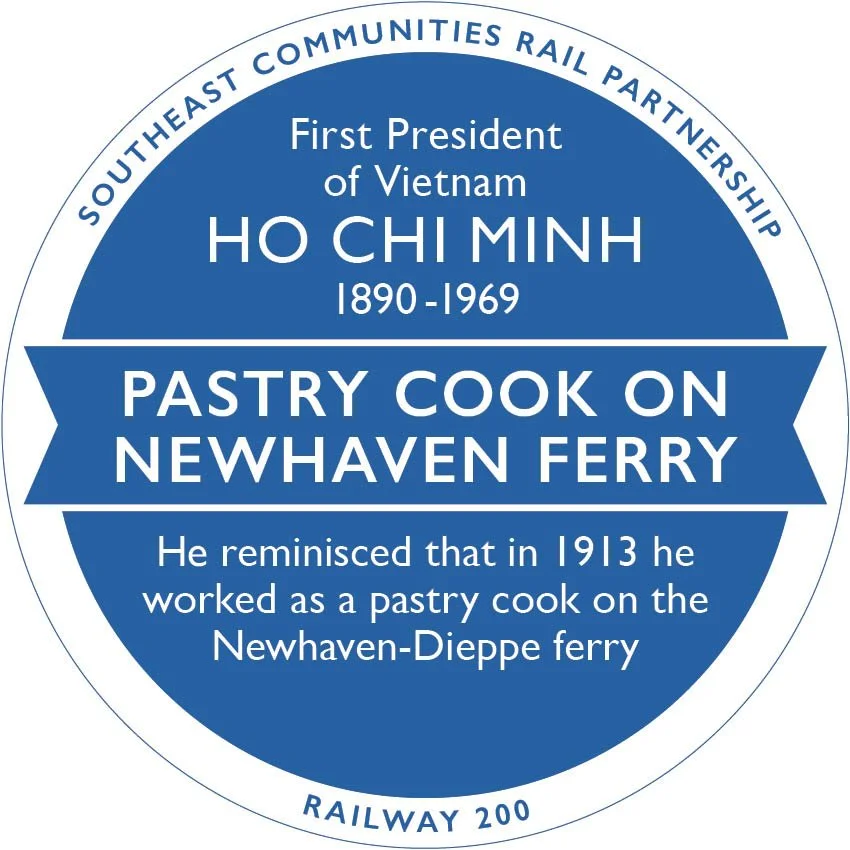
“An unlikely pastry chef from what was then French Indo-China on an early form of gap year, Nguyen That Thanh would become a politician and revolutionary named Ho Chi Minh, and the father of modern Vietnam”
-
An unlikely pastry chef from the French colony of Vietnam (or French Indo-China) on an early form of gap year, Nguyen That Thanh would become a politician and revolutionary named Ho Chi Minh, and father of modern Vietnam.
He formed the French Communist Party in Paris in 1920 and studied in Moscow . The country’s first president from 1945, following its independence from France at the end of World War II, until his death in 1969. The city of Saigon was renamed Ho Chi Minh City in 1976 following reunification of North and South.
His father was a school teacher and Imperial magistrate who was dismissed from his job for being critical of the French. His son took a job on a French steamship in 1911 called the Admirale de Latouche-Tréville on which he travelled widely. He later reminisced that in 1913 he’d worked as a pastry cook on the Newhaven–Dieppe ferry. 100 years on, in 2013, a memorial was unveiled near the RNLI Lifeboat Station at West Quay, Newhaven. It was gifted by the Vietnamese embassy in London to commemorate the 100th anniversary of Ho’s time in ferry kitchens.
“In an industry where so many thousands of accidents occurred, having a proportion of railway workers themselves trained in first aid was a vital supply of immediate medical assistance when an injury or accident took place. The teaching of first aid to industrial workforces was the reason the St John Ambulance Association was founded in 1877”
-
Annie was one of at least nine children born to Esther Philcox and her laundry carrier husband Thomas residing at 9 Toronto Terrace, Brighton in the 1890s. In 1911, agd 24, she was working as a parlourmaid in Paddington, and then in 1921, in her 30s, Annie was describing herself as an ‘ambulance assistant at the Brighton Loco Works’ for LB&SC Railway.
Annie was likely attached to a Corps of first aiders trained by the St John’s Ambulance. In an industry where so many thousands of accidents occurred, not only in urban shunting and goods yards but in isolated rural locations too - so having a proportion of railway workers themselves trained up in first aid and other medical procedures was a vital supply of immediate medical assistance when an injury or accident took place. Railway Companies built up their own first aid Ambulance Movements, offering regular training and awarding badges and medals at large civic ceremonies for those who’d passed the annual refresher exams that had been introduced in 1905. Staff deserving of special attention, who had perhaps saved a life, were nominated for the Order of St John.
The teaching of first aid to industrial workforces was the reason the St John Ambulance Association was founded in 1877.
“Charles sought investors in a fraudulent scheme to build a railway but fled with the proceeds.
And at the gaming tables in Monte Carlo in 1891 over a week he steadily won far more than the day before, exceeding that table’s cash reserves or ‘broke the bank’”
-
Born in Broxbourne, Herts. Charles grew up in Marseille, became a shipyard engineer in 1860s. Invented a device to regulate the speed of a ship’s propellor and moved to Paris where he sought investors in a fraudulent scheme to build a railway but fled with the proceeds, convicted in his absence. Turning up in England he started several other investment frauds and pocketed the money.
In July and November 1891 Charles played the casino gaming tables in Monte Carlo. According to Flaneur in the Sporting Times Charles devised systems for roulette and the card game ‘Trente et Quarante’ and over about a week he steadily won far more than the day before. Winning £9000 one day, £12,000 the next, and £16,000 the day after that (between £1.7m and £2.7m in today’s money?!*). If this was more than the table’s bank reserves at that point in the day a player was said to have ‘broken the bank’ while supplementary funds were brought. A black cloth was ceremonially placed over the table while play was paused.
Before long he was bankrupt and in 1893 spent 8 years in penal servitude for obtaining money by false pretences. He was released in 1899 and published two books on his winning Monte Carlo ‘system’.
Charles had other dubious business affairs in France, including a huge investment fraud operation in 1910 (copied by Charles Ponzi in the USA), and he must have been a regular guest at the London & Paris Hotel at Newhaven Harbour Station on the way. It is said that he held so many riotous parties at the hotel that he was asked to seek alternative accommodation. He would rent the house at 86 Fort Road in Newhaven instead.
He is said to have died penniless in 1922, he was 81.

“Unusually Southern Railway appointed a woman station master - Una’s predecessor Mrs Moore - who appeared in a wartime propaganda film selling tickets and waving her flag to see off trains - to encourage other women to take up work traditionally done by men”
-
Bishopstone Station, is a classic art-deco design, and Grade II listed. It was built in 1938, though the flat roof was modified in 1940 to incorporate two gun turrets, providing 360 degree views of the sea during World War II. It’s the only railway station in the UK equipped with gun turrets!
Kevin Gordon in the Sussex Express in 2006 recalled some of its history:
“The Southern Railway appointed a woman station master which was most unusual at the time.
She was Mrs E Moore and in a wartime propaganda film she is seen selling tickets, talking to passengers and waving her flag to see off trains. The film was used to encourage women to take
up work traditionally done by men. Mrs Moore had previously been a stewardess on the steamship Brighton and she remained on the vessel after it had been requisitioned as a wartime hospital ship. In 1940 the ship was bombed while in Dieppe harbour but Mrs Moore managed to escape into France where she hid in hedges, walking 40 miles to Fecamp. Here she managed to board a coal ship which was able to drop her off in Cornwall. After all that adventure, Bishopstone Station must have been quite dull!”It was reduced to a single track and single platform in 1975, and although it would remain in operation, it was decided that it should no longer be staffed. The last remaining member of staff was station manager Una Shearing until her retirement in 1988.
When the Old Parcel Rooms were renovated as a community hub in 2022 Una was a VIP guest at the opening.Una’s predecessor was in fact Mrs Elizabeth Moore, 1906-1977. In 1939 she was stewardess of the SS Brighton. Her seaman husband was incapacitated by tuberculosis.
“For a few pence a week Ernest had long been a member of the Ancient Order of Foresters, one of the oldest Friendly Societies who ‘shared a duty to assist their fellow men who fell into need’. They had set up the first voluntary Lifeboat Fund in 1864”
-
Ernest was born in Lewes in 1870. He’d worked as a platelayer and was a gardener by the age of 21, and was lodging in Framfield with a couple of other gardeners.
Aged 27 he married farmer’s widow Mary Ann Harding, gaining three step-children and they would have three more together. By 1901 the family of 8 were living at 6 Eastport Lane, Lewes looking across Southover Grange gardens and Ernest was working for a time as a carpenter’s labourer. In 1911, at the same address, Ernest was the nurseryman for LB&SCR and a member of the railway company’s St John’s Ambulance department.
Sadly Mary Ann died in 1915, aged 47. By 1921 Ernest was Lewes station’s gardener, and still living in the same house. However, he remarried in 1924 to Louisa Underwood. He died in 1933, aged 63.
Ernest had long been a member of the Ancient Order of Foresters, one of the oldest Friendly Societies who ‘shared a duty to assist their fellow men who fell into need’. Members paid a few pence a week into a common fund to be able to offer sick pay and funeral grants. They had set up the first voluntary Lifeboat Fund in 1864, and by 1912 became an ‘approved society’ in the early state system of National Insurance. It’s likely that Ernest’s funeral was funded by the Society, and who was represented at the service by a Mr Coleman.
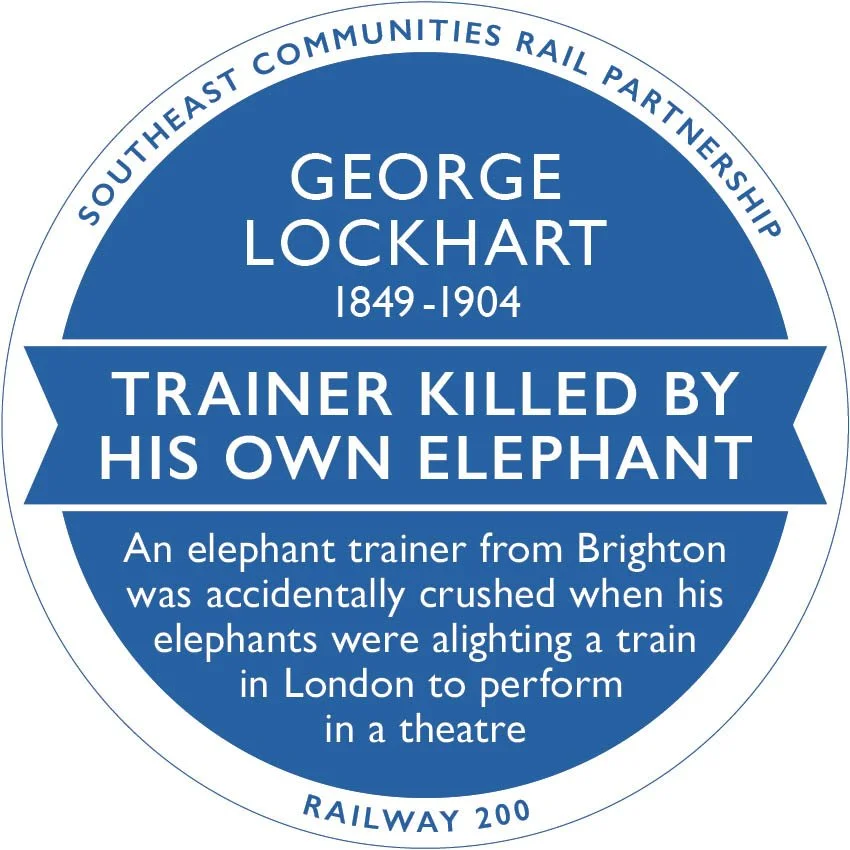
“George toured the country with his elephants by railway. Alighting at Hoe Street Station, Walthamstow, one ‘made off at a trot’ while a baby elephant had broken loose and made its way though the booking office and onto the crowded platform sending ‘the passengers in waiting helter skelter’”
-
The famous elephant trainer George Lockhart was born in Edinburgh in 1849. He and his wife, fellow Scot Nannette Shelton, were residents of the Preston area of Brighton for many years. Their house on Harrington Road they named Elephanta Lodge!
George toured the country by railway with his four performing elephants in covered cattle trucks, each with its own keeper. On Sunday 24 January 1904 the troupe arrived at Hoe Street Station (now Walthamstow Central) in north east London, for an engagement at the New Palace of Varieties. Three of the elephants were ‘babies’ and “in high good humour... trumpeting shrilly and placing their trunks in their trainer’s hand as a sign of their joy at being released from durance vile.” Charlie, the forth and largest and Mr Lockhart’s favourite, wasn’t in such good spirits, perhaps nervous. Normally docile and well-behaved she “made off at a trot towards another part of the goods yard.” Mr Lockhart and a keeper attempted to stop her by catching her rope leash, and the others also broke loose. As Charlie tried to squeeze between trucks Mr Lockhart was crushed between “her massive side” and a rail waggon. His death was witnessed by his own 16 year old son George Jnr. who was naturally overcome with shock.
At the same time a ‘baby’ elephant had broken loose and made its way though the booking office and unconcernedly onto the crowded platform sending “the passengers in waiting helter skelter” but it was soon escorted through the streets lined with onlookers and reunited with the others in the stables at the Palace Theatre nearby. At the inquest into Mr Lockhart’s death, the jury returned a verdict of ‘accidental death’.
In the 1911 census, George’s widow Nanette and son George Jnr. and his wife had left Brighton and the elephant business behind and were lodging in Kilburn in London. George was the proprietor of an early cinematograph hall. But by 1921 George Lockhart Jnr was once again a travelling circus artiste and in 1929 started a 43 year career as a ‘world famous’ ring master.

“A free hot meal was provided each day for all the workers and a dining hall was constructed using old railway carriages enabling 350 people to be fed at each sitting”
-
“The average number of dock workers required each day at the port during the war was 2,500. They were split into three 8-hour shifts. The work was carried out 24 hours a day, 7 days a week.
A special train, for the workers, was run daily from Brighton, picking up at Lewes. It was known locally as the Lousy Lou.
A free hot meal was provided each day for all the workers and a dining hall was constructed using old railway carriages for the walls and tarpaulin for the roof. Two long tables were placed in the middle, with extra tables in the carriages, enabling 350 people to be fed at each sitting.
As the war progressed and hardships were felt on the Home Front, the temptation of Government food and alcohol, bound for the troops in France, sometimes proved too much. All workers were liable to be searched when leaving the docks. Anyone found with Government stores concealed on their person, was arrested. Arrests were made for the possession of sugar, jam, cheese, pickle, cigarettes and alcohol.
The work was not without its dangers. With so many men working on unfamiliar ships, accidents happened. Examples included men falling down the hold, or in between the ship and the quayside. Some of these accidents proved fatal.”
Jenny Flood / Keith Grieves / Newhaven Council

“Unshowy accommodation was found for the mysterious couple at the Bridge Inn. Their worthy hostess Mrs. Sarah Smith conducted the Royal exiles upstairs where the emotions of the worn-out and harassed travellers overpowered them and found vent in a flood of tears. Their 8-day escape ordeal over”
-
There were a number of anti-monarchy revolutions across Europe in 1848. Revolution in the UK manifested in Chartism, a mass movement calling for the right to vote be extended to working class men and thus political influence. Anti-government protests in France developed into an intense uprising in Paris as the February Revolution, gaining control of the city and causing the abdication of King Louis Philippe and the establishment of the Second Republic.
The Illustrated London News presented a full account of their arrival in England with accompanying engravings by Duncan, an artist who had journeyed to Newhaven to make the preliminary sketches.
In disguise the King and his consort were brought across the Channel from Le Havre by the steamship Express commanded by Capt. Paul. They arrived at Newhaven on the morning of Friday 3rd March where unshowy accommodation was found for the mysterious couple at the Bridge Inn. Their identity was soon disclosed to their worthy hostess Mrs. Sarah Smith and she “conducted the Royal exiles up-stairs. On reaching their apartment, the emotions of the worn-out and harassed travellers overpowered them, and found vent in a flood of tears.” Their 8-day escape ordeal over.“The Royal party, which consisted of seven persons, occupied two sitting and six bed-rooms, independent of a large room 60 feet in length which was appropriated to the attendents.” A letter to her Majesty Queen Victoria was entrusted to and conveyed by Mr. Irons, the secretary of the Brighton Railway and Steam Packet Co. and clothes were purchased for them in Brighton to “repair the deficiencies of the Royal Wardrobe” while bags of French silver coin were changed into English money.
A great deal of visitors having heard of the esteemed guests arrived at the Inn to pay their respects to the ex-King, and their departure on Saturday 4th March was further “intercepted at every step by fresh comers” such as scholars from Lewes Free Grammar School. After much handshaking and thanksgiving the Royal party boarded a special train that had arrived for them at Newhaven and they departed for London at 11 o’clock.
The Bridge’s respected landlady for 50 years was Mrs Sarah Smith. She was born in Sussex in 1791. She was widowed and retired in the 1850s, but remained for a time at the Hotel as a resident. She died on 4 Nov 1864.
ARUN VALLEY LINE
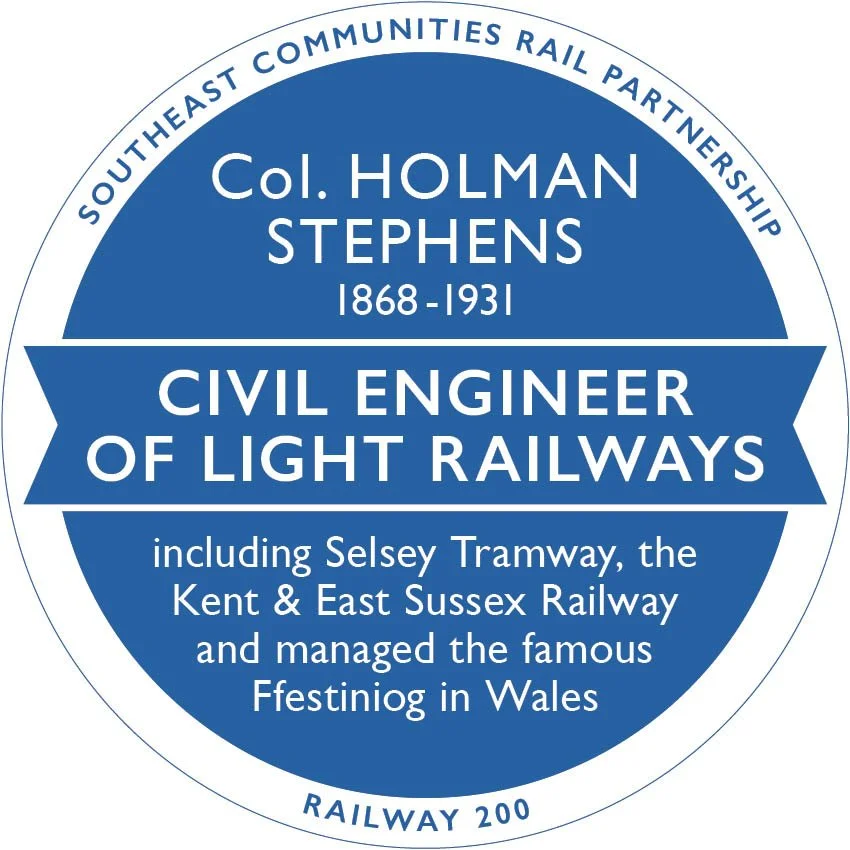
“‘Holly’ was the son of a Pre-Raphaelite artist and art critic. In 1890, aged just 22, his first railway build was the Cranbrook & Paddock Wood Railway followed by the Camber to Rye”
-
Holman or ‘Holly’ was the son of Pre-Raphaelite artist and art critic Frederick G. Stephens and his artist wife Rebecca née Dalton. His father gave Holman a working model railway as a gift. Apprenticed into the Metropolitan Railway at 13 he became an assistant railway engineer, and was developing an interest in the military. By the age of 15 he was 6’2” (188cm).
In 1890, aged just 22, his first railway build was the Cranbrook & Paddock Wood Railway followed by the Camber to Rye. He was made an Associate Member of the Institution of Civil Engineers in 1894.
The Light Railway Act 1896, offering reduced construction and safety standards in exchange for slower speeds, was intended to give rural communities not served by the main Companies an opportunity for railway services, however limited. The take-up was disappointing but Holman bucked the trend and became expert in building them. After a 4 month build in 1897 he opened The Hundred of Manhood & Selsey Tramways Company Ltd line. Seven-and-a-half miles of track and 11 stops between Chichester and the coastal peninsula of Selsey.Selsey’s annual passenger numbers peaked at 105,169 in 1916, but by the 1930s passengers were switching to the more reliable bus service and the one-train-a-day tramway closed in 1934.
Holman is associated with 18 railway lines including the Rother Valley (later the Kent & East Sussex) in 1900; the Festiniog & Welsh Highland Railways; the Weston, Clevedon & Portishead, and a number of industrial railways serving freight or lead and ironstone mines.
His army career included him recruiting 600 men to serve in the Royal Engineers in the Boer War (1899- 1902), and reaching the rank of Major. In the First World War he had some responsibility for searchlights. Living such a peripatetic life, spending time way from home in the forces and visiting his railways, may have contributed to him remaining a bachelor.
When he died in 1931 his estate worth about £1.4m in today’s money was divided between four colleagues at Tonbridge: William H. Austen, Alfred and George Willard and James Iggulden Esqs.
Colonel Stephens Society colonelstephenssociety.co.uk

“From 1837 WHSmiths formed distribution deals with early railway companies, enabling the UK to develop nationwide press. 233 years after its first stall, Smiths could boast 1700 stores in 30 countries”
-
Ernest was born in Dorset in 1906 to Fanny and Edward Wills, a gardener. By 1921 the 15 year old Ernest and his family living were on London Road, Pulborough. He was working at the railway station as a WH Smith’s bookstall assistant. His 21 year old sister Winifred was a buffet attendant for Bertram & Co at Havant station and his sister Ivy, 18, was a LB&SC Railway booking clerk at Fittleworth station.
In 1935, aged 29, he married Lily Newman and they had two children, likely named Raymond and Eric. Ernest had become branch manager at the WH Smith’s at Edenbridge station in 1935, where he stayed until 1969. Joan Varley recalled “14 year old Violet Harrison also worked at Edenbridge WH Smith’s before joining the Wrens in the Second World War. She remembers the newspapers arrived by train and the paper boys sorted them for delivery.”WH Smith & Son began in London in 1792 as a newspaper stall run by Henry Walton Smith, but taken
on by his son William Henry who opened the first W.H. SMITH & SON newsstand at Euston Railway Station in 1848 with his own son, also called William Henry. They were the first newsagent to distribute newspapers by rail. Sam Hewitt for The Railway Magazine writes: “From 1837, Smiths began tying up its own distribution deals with many early railway companies and in February 1848 showed the world what was possible by chartering a special train to deliver papers containing news of a Government budget speech”. Thus enabling the UK to develop nationwide press to rival the local newspapers.233 years after that first stall, Smiths’ could boast 1700 stores in 30 countries.
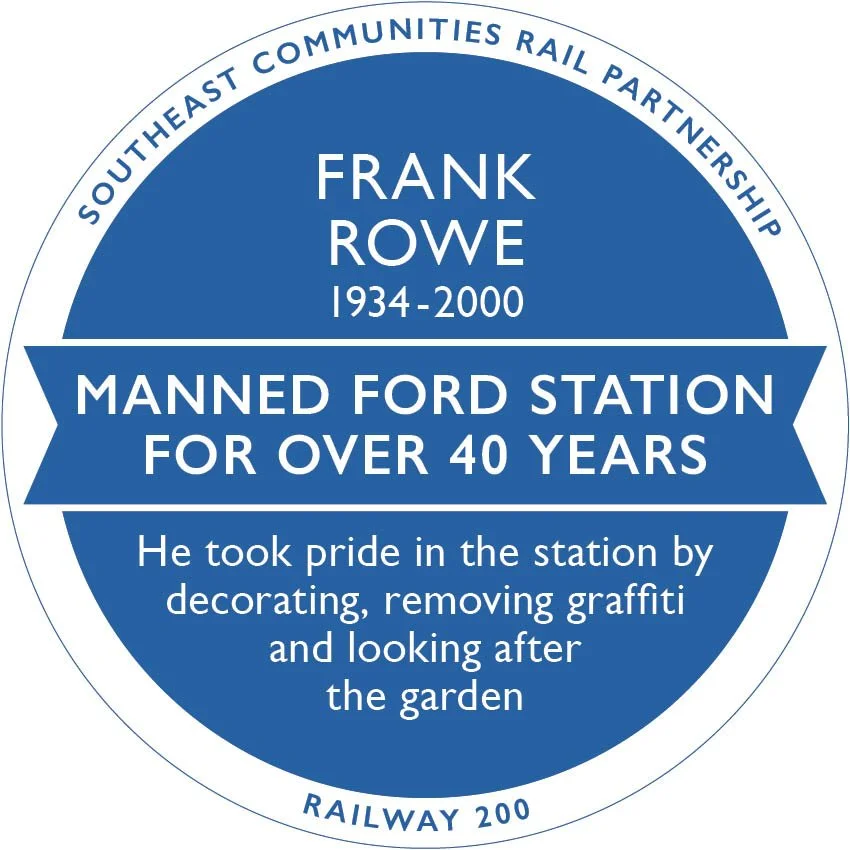
“Frank looked after the station completely himself – he painted and decorated, removed graffiti, looked after the garden, and often worked past the hours he was paid for”
-
Littlehampton’s Frank Rowe manned Ford station for over 40 years. The Littlehampton Gazette reported, after his death, in 2001 that Frank “actually looked after the station completely himself – he painted and decorated, removed graffiti and looked after the garden he had there. He often worked past the hours [he was] paid for. He was well liked by staff and customers alike”
A plaque was erected and a tree planted in his memory in 2001.

“Working in Southern Railway’s publicity department he was tasked with fielding locomotive-related enquiries from rail enthusiasts and he saw a market for published lists of locomotive names and numbers. Trainspotting was born”
-
Ian was a railway enthusiast from a young age with dreams of becoming a stationmaster and general manager. In 1937, aged 15 he had an accident during army training which led to him losing a leg. Now technically disabled he couldn’t become an apprentice on the railways and fulfil his ambition. And yet, his enthusiasm got him an office job at Waterloo in 1939, in Southern Railway’s publicity department, where he learnt about print production. He was tasked with fielding locomotive-related enquiries from rail enthusiasts that he saw a market for published lists of locomotive names and numbers. Southern weren’t interested so he self-published. His first edition came out in 1942, the pocket-sized ‘ABC of Southern Locomotives’, selling 2000 copies. New editions soon followed, and within a year he’d added all major railway locomotives and London Underground trains, trams, buses and trolleybuses. Trainspotting was born.
He left to set up his own publishing company and also founded the Locospotters’ Club. In 1946 he watched Laurel and Hardy reopen the Romney, Hythe and Dymchurch Railway. By the 1960s his company, whose boardroom was a Pullman carriage beside Shepperton Station, published books and magazines on all types of transport. Still in his early 40s he was able to acquire a private 7 1⁄4in gauge railway that he relocated to Chertsey and named Great Cockrow Railway. It was to carry children of all ages at express-like speeds along its two miles of track - and still does, boasting a fleet 45 steam locomotives! Ever the entrepreneur he started selling Miniature Railway Supplies, he bought hotels, manufactured masonic and military regalia, a small chain of garages, and even an organic seed and seaweed feed company.
Ian Allan’s obituary in the Guardian theguardian.com/ian-allan
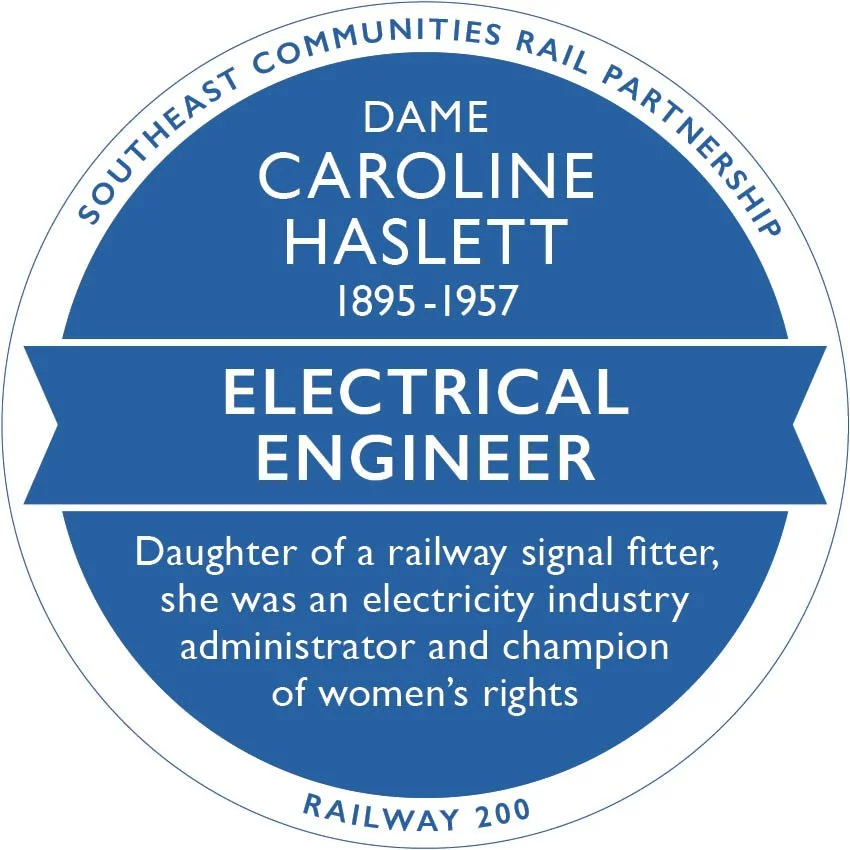
“During WWII she was the only safety expert, and woman, on the committee discussing recommendations for electrical installations in post-war rebuilding. The concept of the Fused-3-Pin-Plugs and Shuttered Socket-Outlets came out of these discussions”
-
Brighton-born couple railway signal fitter Robert Haslett and his wife Caroline lived on New Road, Worth and had four surviving children Georgina, Robert, Rosalind and Caroline, the eldest.
At 15 Caroline was training to be a teacher, and according to her sister Rosalind, had become a suffragist by 18, despite her father’s objections. At a Suffragette dinner Caroline was delighted to find herself sitting next to the renowned Mrs Emmeline Pankhurst, who upon hearing that Caroline hoped soon to become a fully qualified engineer, said to her: “But surely that’s a very unsuitable occupation for a lady, isn’t it?” Somewhat taken aback Caroline put Mrs Pankhurst in her place, telling her that doing a job in the right way was more important than whether it was done by a man or a woman.
During WWI Caroline went to work as a clerk for Cochran Boiler Co. in Scotland, and got a basic engineering training while she was there. In 1918 she joined the Women’s Engineering Society becoming its first secretary and later its President and founder and editor of its journal The Woman Engineer.
She helped start an engineering firm for women in 1920, was the only woman to speak at the World Power Conference in Berlin 1930 and for much of the decade was chair of the Home Safety Committee.
In 1931 she received a CBE for services to women. She championed the use of electrical appliances to ease womens’ domestic drudgery, becoming the first Director of The Electrical Association for Women. Numerous other roles followed. During WWII she was the only safety expert, and woman, on the committee discussing recommendations for electrical installations in post-war rebuilding. The concept of the Fused-3-Pin-Plugs and Shuttered Socket-Outlets came out of these discussions, and was implemented in 1947.
She was awarded a DBE and in 1948 was on the board responsible for the nationalisation of the UK’s electricity supply. In 1950 a new motor collier ship was named in her honour. Fittingly it was employed laying cross-channel power cables later on.
Caroline retired through ill health, and in 1957 she died at her sister’s Suffolk home - named ‘Worth’ after the village where they were born. It is said that her body was cremated, unusually, by electrical heated furnace at her request.
theengineer.co.uk/late-great-engineers-caroline-haslett-a-life-electrifying
Womens’ Engineering Society
wes.org.uk/heritage/our-history

“He was one of the founders of the Institution of Locomotive Engineers and presented its first paper, aged 21, on the subject of French locomotive practice. At Bognor he organised staff outings to the Continent every year, putting to good use the seven languages he’d learned to speak fluently, including Dutch and Flemish!”
-
John Pelham Maitland was born in Croydon in 1890 to Anna and John T. a whiskey distiller and dealer. They lived with Anna’s wealthy parents in Croydon for some time. He was apprenticed to the railways in Brighton in 1907 and by the age of 21 was working as an ‘erector (locomotives etc)’ for the LB&SCR.
At the same time he was one of the founders of the Institution of Locomotive Engineers and even presented its first paper, still just 21, on the subject of French locomotive practice. He wrote a later paper on Coal as a Factor in Locomotive practice.He married Evelyn Bennett in 1917, and they had a daughter. John was now a mechanical engineer and outdoor foreman at Brighton. According to railway historian Fred Rich, John “was in charge of the sheds at Newhaven (from 1924), at Littlehampton and Bognor (from 1929), at the new Motive Power Department at Norwood Junction from 1935 and was Running Shed Superintendent at Nine Elms from 1939 until his retirement.”
At the time of his move from Bognor the West Sussex Gazette 20 June 1935 wrote: “At Bognor he had a hand in extensive improvements in the working of ordinary and tourist traffic, and he has also acted as President of the Bognor Regis & District Railway Athletic Club..”
He organised staff outings to the Continent every year, putting to good use the seven languages he’d learned to speak fluently, including Dutch and Flemish!As a Southern Railway Superintendent during the evacuation of troops from Dunkirk in June 1940, John was awarded an MBE (in 1944) for his role in coordinating trains from the coast. He retired in 1950 and planned to travel to Europe and America, with ambitions to pursue his hobby of ‘castrametation’ - the history of ancient fortifications. He died in 1964, aged 74.

“During WWII Jack had worked on occupied German railways. He recalled that during wetter winters you had to row a boat across the swollen river between Amberley and Pulborough to reach the signal box”
-
‘Jack’ Lisher was born in Houghton near Amberley in 1924 to Winifred and John Lisher, a railway signalman (whose father John was a railway porter, whose father John before him was also a railway porter!)
By 1939, now with three children, the family were living at No 2 Railway Cottage, Hardham, Pulborough. Father John was still a signalman, and 15 year old Jack was a porter.
During the Second World War Jack joined the Royal Engineers, where he worked on occupied German railways. Back at home, he was working as a signalman like his father. Jack recalled to the Lancing Herald newspaper that during wetter winters you had to row a boat across the swollen river between Amberley and Pulborough to reach the signal box there. At Amberley the job involved running the Post Office too, giving out pensions as well as train tickets. Jack met his future wife Joyce Jones when they both worked at Amberley station, they married in 1957.
Later, as a rural relief signalman, he worked at 32 different signal boxes across Sussex - gaining a certificate from each one after a period of training specific to that location. In 2002 he donated all 32 certificates to Littlehampton Museum for their collection of railway memorabilia.
He died in 2003.

“In 1967 Trevor may have set a record for the most rail miles covered in two weeks when he travelled 11,483 miles by train in 280 hours!”
-
As a child Trevor used his pocket money to explore the rail network and, it’s not clear why, but in 1967 Trevor may have set a record for the most rail miles covered in two weeks when he travelled 11,483 miles by train in 280 hours!
In 1970 Trevor, and fellow rail buff John Vaughan frustrated by Southern Railway’s lack of special excursions, hired one themselves for £800 one Sunday. It was a 10-coach diesel express train for nearly 500 passengers from Worthing to Torquay. ‘The West Sussex Railway Touring Trust’ was born, offering tempting fares two-thirds cheaper than Southern fares, with any profits going to charity. It sold out pretty quickly. And they were soon organising two such trips a year. In 1974 a record number of 680 passengers travelled from Hove to Torbay one Spring bank holiday. For the Edinburgh Tattoo passengers travelled overnight in both directions, and were greeted on arrival by a military band playing the Sussex Anthem ‘Sussex By The Sea!’
Championing passengers - as part of the Arun Valley/West Sussex Rail Users Association - Trevor constantly challenged poor service. Angry that the 8.43am Bognor to London Bridge trains had only arrived on time on five occasions in November ‘96 he was in the press railing against Connex South Central, the private company that had taken over from British Rail some months before. Trevor helped secure the long term future of railway routes that had been options for closure, using creative thinking to suggest running shorter trains more often would release rolling stock for those lines earmarked for reductions or closure. Always devoted to improving people’s lives.
Following his death in 2022, Govia Thameslink Railway commissioned a bench, created for Chichester station by the Southern Rail West Coastway maintenance team, as a tribute to Trevor.

“Repairs to the station clock included replacement face and hands, and a specially mixed mauve-purple paint to match its original colour”
-
A sales clerk at Billingshurst for 12 years, sadly Dave died in service in April 1999.
Chichester Line Manager Keith Brown, of Connex Rail, took this as an opportunity to have the Billingshurst station clock restored in Dave’s honour. The clock dates from 1860 when the line was the London, Brighton and South Coast Railway. It hadn’t worked for many years. Repairs included replacement face and hands, and a specially mixed mauve-purple paint to match its original colour.

“Barry started his employment with British Rail as a Box Boy at Horsham”
-
Barry was a signalman for 40 years. In 1972 he started his employment with British Rail as a Box Boy at Horsham, then a signalman jobs at Warnham and Crawley, becoming relief signalman at Horsham in 1979. In 1983 he identified for a job at Three Bridges Signal Centre and in 1988 he was given a Gatwick Express Supervisors job. In 1990 he returned to Three Bridge signal box and retired in 2012.
He became a life member of the Horsham Signal Box Preservation Society in 2014.
SUSSEX COAST LINE
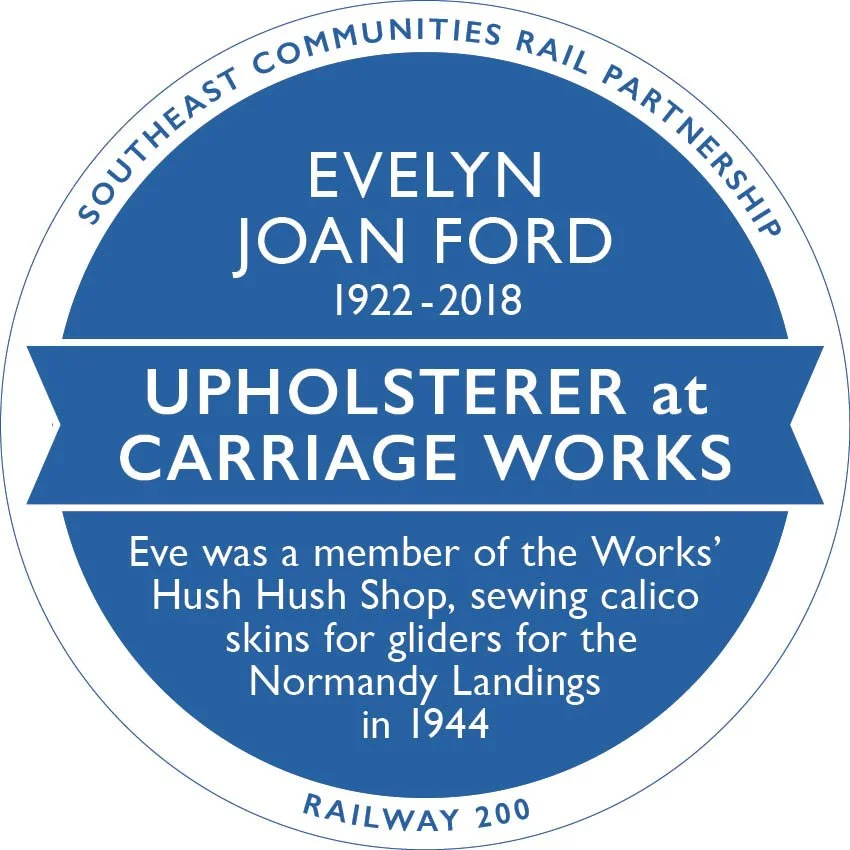
“Evelyn’s dept. worked on secret missions for the Army making floats for the Bailey Bridges and the overlays for the Horsa Gloder planes used in the Normandy Landings”
-
Evelyn trained as a tailor and dress maker. She worked at Lancing Carriage Works in the upholstery department during World War 2 in the ‘Hush Hush’ shop, working on secret missions for the Army supporting the war effort.
She spoke about making floats for the Bailey Bridges and the overlays for the troop-carrying Horsa glider planes, which were used to support the Normandy Landings. Evelyn was always very proud of the work they undertook.
Evelyn Steadman was born in Brighton on Christmas Eve 1922. As a teenager in 1939 she worked in hosiery manufacturing and lived on Islingwold Place in the Hanover area of Brighton. By the time she was working at the Carriage Works she was living in Hove and travelled every day on the ‘Lancing Belle’ train to work everyday. She used to tip a lad’s hat off who worked at the railway station as he was seeing the train off safely from the platform. She married him, Horace Ford, on 20 October 1945 and they moved to Ferring and started a family.
Horace, known as Henry then, moved and worked at Worthing Railway Station as platform guard and chargeman. He would get flower displays ready on the platforms.
Horace died in 1985, Evelyn outliving him by 33 years, on her death in 2018 she was 96.
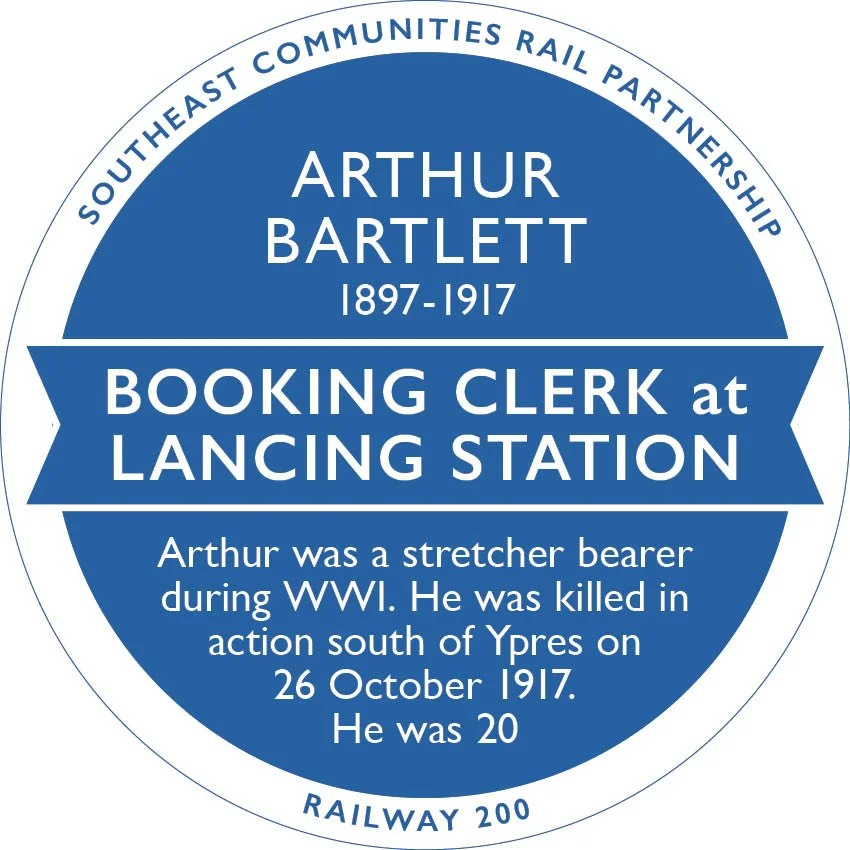
“20 year old Arthur was killed struggling through waist deep mud and machine gun fire, attempting to rescue wounded men lying in water-filled shell holes”
-
Private 10497 Arthur Reuben Robert Bartlett enlisted on 27th February 1917. He served in the 2nd Batallion Honourable Artillery Company as a stretcher bearer.
Arthur was killed in action on Friday 26th October 1917 aged 20 years struggling through waist deep mud and machine gun fire, attempting to rescue wounded men lying in water-filled shell holes, working under very heavy fire. He was killed by a piece of shell, south of Ypres near Vierstraat.
He was baptised at St James The Less on 6th June 1897. He lived at 2 North Road, Lancing. He worked as a booking clerk at Lancing Railway Station. Arthur’s grandfather was postmaster at Lancing Post Office.
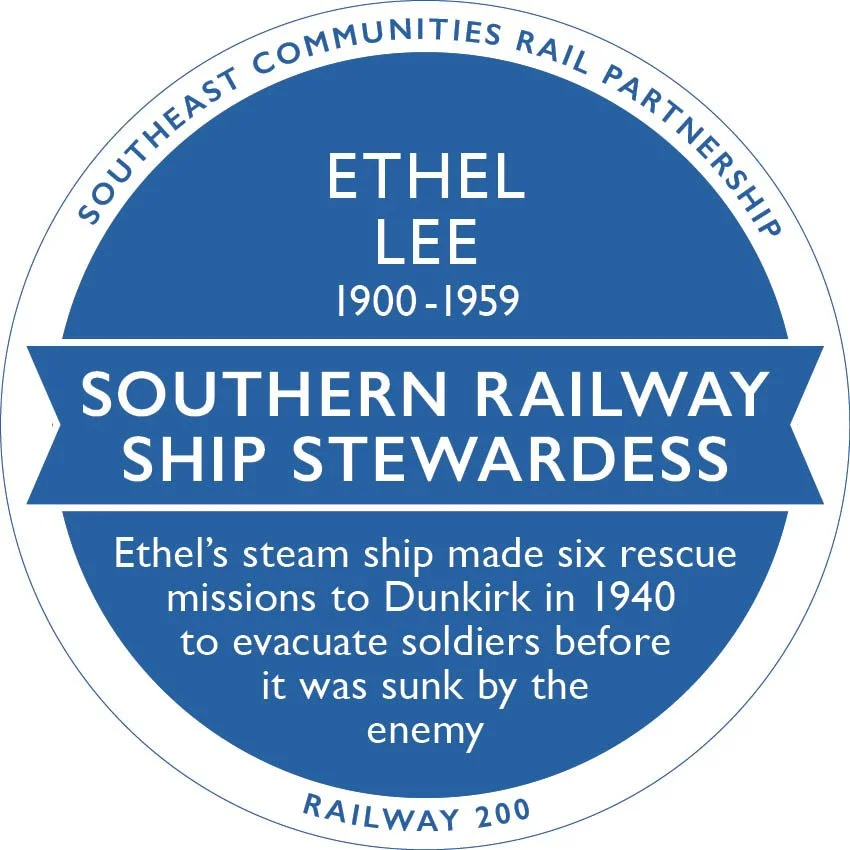
“The boat was attacked by enemy planes and a bomb hit it amid-ships. Ethel was in the water for over one and a half hours”
-
Ethel Lee took part in the evacuation from Dunkirk. She was acting as a stewardess on a cross-channel boat which was making its way to Dunkirk to rescue survivors. The boat was attacked by enemy planes and a bomb hit it amid-ships.
For over one and a half hours Mrs Lee was in the water swimming and occasionally floating on her back to rest. Mrs Lee was born in Lewes and lived in Newhaven.

“Harold’s widow Wyn had to send her young daughters to an orphanage. Linda at 3 1⁄2 years old and Sylvia aged 18 months were placed in the care of The Southern Railways Orphanage at Woking”
-
Harold Dray was born at Canterbury Kent on 22nd January 1913 to parents Elizabeth and Harold. Harold Snr worked in the stores at Southern Railway in Ashford – at 16 years old Harold Jnr started a 5-year apprenticeship there and at 21 years old became a fully qualified “coach trimmer”.
The carriage-works at Ashford was closed and all railway carriage construction was concentrated at Lancing West Sussex. Approximately 500 men transferred to work at the Lancing carriage-works. Harold in his early 20’s relocated from Ashford to Lancing sometime between 1934 and 1937 going to lodge with family at Shoreham- by-sea.
Harold met local girl Winifred Lilian Mockford and they married at St Michael & All Angels Church in Lancing on Saturday 27th March 1937. Winifred [Wyn] was born in Sussex on 27th August 1916. She had been working “in service” as a housekeeper in Maidstone, perhaps she had met Harold while she was living in Kent. Harold and Wyn began their married life in a property called ‘Lido Villas’ on the sea-front at South Street, Lancing. Their first child, Linda Mary was born on 26th March 1941.
In the early morning of Friday 25th April 1941 a German plane, being chased from London by the RAF jettisoned a bomb before flying out to sea. It was a direct hit on Lido Villas and reduced the property to rubble. Wyn was in bed, baby Linda was in the cot and Harold was in the bathroom getting ready to go to work at Lancing carriage-works. Wyn threw herself on top of the cot; she and the baby were rescued uninjured and taken to neighbours at The Three Horseshoes pub next door to keep them safe and warm. Harold was seriously injured and taken to hospital in Worthing.
The German plane was shot down. The pilot survived and was rescued from the sea near Worthing Pier and taken prisoner.
Harold and Wyn were eventually housed in a bungalow in Lancing Park and their second child Sylvia Jean was born on 28th January 1943.
Harold was ‘called up’ to The Royal Army Service Corps [General Transport] and was posted on Thursday 5th March 1942 for training at Beacon Barracks, Bulford in Wiltshire. The Army paid an allowance to Wyn and the children as his dependants.
Harold was part of the Allied Expeditionary Force which landed on the beaches in France in June 1944. He was fatally wounded on D-Day by shrapnel to his left side and both legs and he died on 7th June 1944 at a casualty evacuation centre on the French beach. Wyn received confirmation that Harold was ‘missing in action’ but confirmation of his death did not come until October. As soon as that notification was given, the financial allowance paid to her and the children ceased.
In the family archives there are three letters – written in pencil – to Wyn from Private C.H. Bennett who had been a great friend of Harold’s and had tried to find him when he was wounded. Private Bennett’s letters indicate that Harold [Hal to his mates] was very popular and well-liked by his comrades. Private Bennett survived the war and returned to Scotland but he made a trip down to Lancing to visit Wyn and return Harold’s identification dog-tags to her. Private Bennett told Wyn that overnight on 6th June 1944 the casualty evacuation centre had been bombed and all nursing staff and patients had been killed.
Without financial support, Wyn found paid employment making and packing ‘chaff’ which was used as radar counter-measures by British warplanes. Wyn had to send her young daughters to an orphanage. Linda at 3 1⁄2 years old and Sylvia aged 18 months were placed in the care of The Southern Railways Orphanage at Woking Surrey. The Woking Orphanage accommodated 150 children whose fathers had died during their employment on the railways. The building latterly became part of ‘Woking Homes’ a home for retired railway and transport personnel and their spouses.
In July 1947 Wyn re-married. Reginald James Shorter [Reg] was a locksmith at Lancing carriage-works. He had relocated from the Ashford carriage-works and had worked alongside Harold. Reg wasn’t able to join the Regular Army due to his poor eyesight but he did serve with the local Home Guard throughout the war.
Reg and Wyn immediately brought the girls out of the orphanage and in August 1947 they became a family. Linda aged 6 1⁄2 years joined the Lancing Junior School and Sylvia joined Lancing Infants School.
Reg worked for the Carriage Works until it closed in the 1960s and he subsequently trained as a carpenter at Beamish on Shoreham Harbour until he retired.
Reg and Wyn lived in the bungalow at Lancing Park. Reg died in 1986. Wyn sold the bungalow in 1995 and retired to Ireland alongside her daughter Linda. Wyn died in Ireland 2009. Linda didn’t have children but Sylvia had two children [Sharon and Joanne]. Sylvia died in 2018. Linda, is now aged 83 and living in Staffordshire. Linda visited Lancing with Sharon during Remembrance in November 2024 to take part in a memorial service at Lancing Station and to lay a wreath in memory of her father Harold whose name is inscribed on the war memorial. Sharon has vowed never to forget the service and sacrifice of the grandfather she never knew – Harold Dray.

“Southern Railway alone had recruited 7,000 women for a variety of jobs. Sarah was their first woman motor driver, driving a ‘mechanical horse’ a Scammell goods delivery van"
-
Sarah Chesterman is mentioned in a newspaper article from December 1942. It was the Worthing Herald, but the story was repurposed across other titles at the time too. The headline is 'Women do big jobs on the railways. Mere man's tribute - We'd be in a mess without them".
It describes how Southern Railway alone had recruited 7,000 women for a variety of jobs. A number of them described in the article. For example Miss Osborne, a bookkeeper now ‘pickling’ train windows with a cleaning acid before they’re washed down and Miss Sarah Chesterman, 33, “the first Southern Railway woman motor driver… driving a ‘mechanical horse’ a Scammell goods delivery van” She said the work was “a pleasant change from serving in a store”.
The 1939 register shows only one possibility for Sarah (born 16 Oct 1908). We can assume that she didn't marry as she kept her birth name to the last. Her parents and siblings were in Oxfordshire. She was buried back in Kidlington - where her relatives may still be.

“Ernest signed up in August 1914 and his heavily pregnant wife Rose gave birth to their daughter Nellie just a few weeks later”
-
Gunner 374377 Ernest Strudwick of the 173rd Siege Battery Royal Garrison Artillery.
Ernest was killed in action on Thursday 21st March 1918 aged 32 years. A casualty of the German Spring Offensive, killed by a shell and buried where he fell. He’s commemorated on the Arras Memorial to the missing.
Ernest Strudwick was born in Thakeham, Sussex and baptised there on December 6th, 1885, the eldest child of Alfred and Deborah Strudwick. The family moved to Lancing in 1890, and in 1905 Ernest married Rose Grinyer. Their family quickly grew and by 1911 they were living at St. Kilda, Penhill Road with children Dorothy, Percy and Gertrude (daughter Nellie arrived in 1914) Ernest was working as a garden labourer.
At the outbreak of war, he joined the staff at Southern Railway Carriage Works as a Lifter.
Ernest had two brothers in service and who survived the war: Alfred was in the Royal Fusiliers, he had what may be termed a remarkable escape from death at 19. He received a bullet wound deep in the neck, but providentially no big blood vessel was injured. Brother Horace was a driver in the Army Service Corps, formerly in the employ of market gardener Mr. Gooderham, .
Read Sue Light’s full account here
lancingwarmemorial.blogspot.com/strudwick-ernest.html
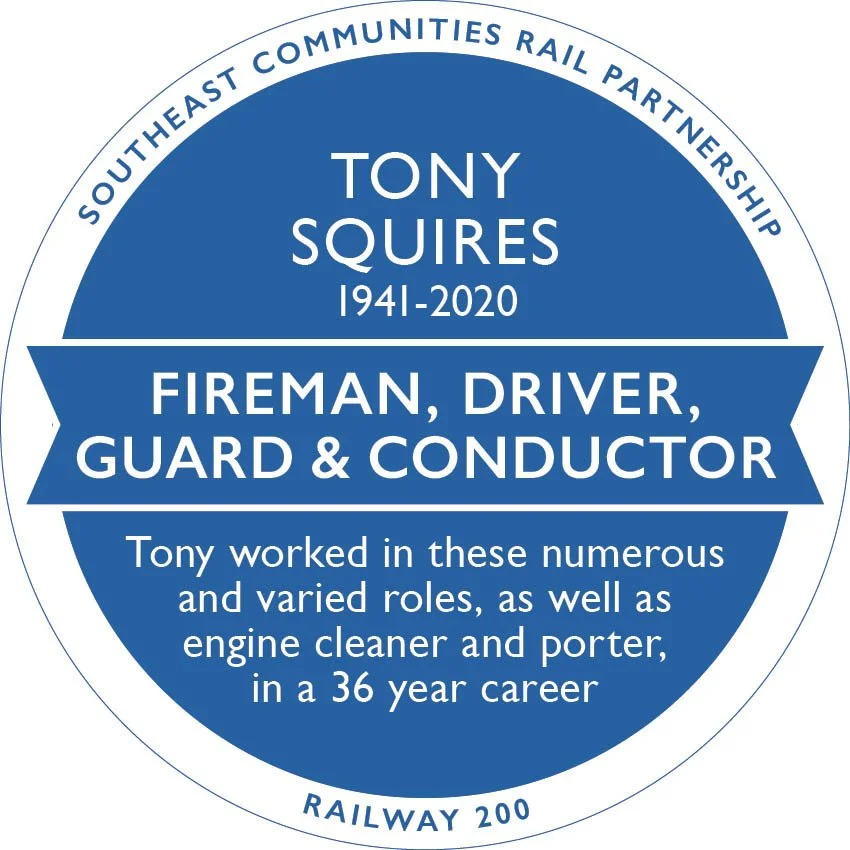
“Tony was the conductor on the train that crashed at Purley in 1989 in which five people died. He was in the guard’s van that rolled down the embankment. Despite his injuries, he returned to the train and scrambled up the muddy slope to help others”
-
Anthony Squires was born in 1941.
He joined the railways in 1965, and married Wendy Knight in 1967. They had two children.
According to James Butler at Sussex World news, ‘Tony's career included stints as a steam train driver in Horsham and later a railway conductor, in which he negotiated pay rises for colleagues through work with his union, the NUR’.
On 4 March 1989 Tony was the conductor on the 12.17pm train from Littlehampton to Victoria, which was involved in a crash at Purley, in which five people died and 94 were injured. The Argus newspaper recalled later how ‘Tony’s guard’s van had rolled down the embankment and he was bruised and covered in blood. Despite his injuries, he returned to the train and scrambled up the muddy slope to help others. Speaking after the crash, he said: “I’m no hero. I just did what had to be done.”
He was also a Local Councillor for a time, and on two occasions served as Littlehampton’s Mayor.

“William had paid into the Railway Union Orphan Fund, and on his death, a small weekly sum to contribute to the upkeep of his children was 13/6 per week (around £33 now) until each child reached the age of 14”
-
William was born in Reigate in 1880. He lived and worked in Tunbridge Wells, before marrying Mary Ann Hall in Sussex in 1906. He started work for the London, Brighton & South Coast Railway that same year, in Littlehampton.
He was employed as a ‘carman’ – a carter who would drive a horse-drawn vehicle, collecting and delivering goods to and from the station.
He and Mary had six children between 1907 and 1919, living at 12 Gloucester Place and later at 44 Maxwell Road. Tragically William died at work on 14 June 1920, in an accident at the stables at Littlehampton station.
According to railway historian Mike Esbester, William paid into the National Union of Railwaymen’s Orphan Fund, which meant the Union provided a small weekly sum to contribute to the upkeep of any children. They received 13/6 per week (around £33 now) until each child reached the age of 14.
You can read more on Willliam’s fatal accident here:
railwayaccidents.port.ac.uk/william-betterton

“In its earlier days, Angmering station wasn’t just a railway station, as the station master also served as the local postmaster”
-
All change! When the railway first came to our villages by Graham Lewis, with acknowledgements to Richard Standing
The opening of Angmering Station on 16th March 1846 altered the face of travel in Rustington, East Preston and Angmering, bringing about significant social and economic changes to this largely agricultural area. Many more people were able to explore the world beyond their rural village, and in an era when roads were notoriously bad, the faster journeys achieved by train enabled the coastal strip to develop a successful market gardening industry, with produce travelling to London and beyond. Tomatoes and flowers were the principal crops.
The construction of Britain’s railways began in the 1830s in the hands of a large number of independent companies, authorised by parliament, but with no overall plan or co-ordination. The London & Brighton Railway Company was responsible for the scheme to link these two centres of population, but it seems a line westward along the coast from Brighton had always been an essential part of the scheme. In 1837 the company was given permission to build a line from Brighton to Shoreham, as well as its main line from London. As a port, Shoreham was a potentially profitable destination, but it was clearly foreseen that a line westwards from there was desirable.
A few years later, the London, Brighton & South Coast Railway was formed from several smaller companies and it was the LBSCR which built the line we know today, reaching Worthing in 1845, followed by Angmering and then Chichester in 1846.
Leaving Shoreham, the first station on the new line was Lancing, followed by Worthing, Goring and Angmering. The original station at Angmering appears to have been an attractive flint-faced building with twin gables. After Angmering, the next station was called Littlehampton, though this was situated near the level crossing in Lyminster, two miles north of the town. The next station was Arundel (now Ford station) and the spurs to the town centre stations in Bognor and Littlehampton were added in 1864. Barnham Station was built in that same year.
The 1853 passenger timetable shows that there were four daily trains from Angmering to Brighton and four trains a day to Portsmouth. To travel to London, a change at Brighton was essential, as the loop between Hove and Preston Park wasn’t built until 1879.
In 1854, Angmering Station was provided with a goods yard on a large piece of land to the north of the line, donated to the LBSCR by the Squire of Ham Manor, William Gratwicke. The goods yard is now the station car park but the old engine shed still stands today and is used by a tool hire business. The second (and present) station building, dating from the 1860s, included a house for the station master or other key staff. A signal box was constructed in 1877 on the south side of the station adjacent to the level crossing, but this was removed in the 1990s when the signalling system was centralised.
In its earlier days, Angmering station wasn’t just a railway station, as the station master (sometimes designated simply as a “clerk”) also served as the local postmaster. From here, mail for Angmering, East Preston, Kingston and Rustington was sorted and distributed. The opening of Angmering Station didn’t just transform the local economy and people’s way of life. It also resulted in the name of the road leading from Rustington to East Preston being changed from East Street to Station Road, and the latter name continues right through Angmering to Water Lane.

“Ernest became a National Union of Railwaymen member at the age of 18, as a porter for the LB&SC railway”
-
Ernest was born in Rotherfield on 29 December 1900 to Catherine and David Morley, a railway signalman.
Ernest became a National Union of Railwaymen member at the age of 18, as a porter for the LB&SC railway through the Tunbridge Wells Union branch.
By 1921 he was a porter and signalman at Eridge, and his porter colleague there Albert Moon, was the family’s lodger.
Ernest married Daisy Taylor in 1924, and by 1939 they were living at Old Station Cottages, Lyminster Road, Wick, with one child possibly Doris. Working at Lyminster Crossing for 40 years. He would’ve retired around 1965, but died only a couple of years later.
Project funded by these railway companies through the Southeast Community Rail Partnership

-
If you’re unfamiliar with Danny’s plaques: where English Heritage’s ceramic blue plaques, as you know, celebrate famous, creative or otherwise successful people. Danny has been creating blue plaques for real, ordinary people like you and me - particularly for people that lived over 100, 150 years ago. What might’ve seemed like ordinary jobs at the time, can remind us today of how life, fashion and technology was often so much different then. Jobs such as ostrich feather curler (for those Victorian hats!) or ivory carvers, tallow melters, even cinema usherettes are jobs of the past.
For Railway 200 the plaque design has a vintage, railway feel, sharing the typeface on mid-century railway signs, posters and leaflets; and the fishtail shape of the enamel cap badge worn by uniformed railway staff in the 1950s and 60s, that displayed each employee’s role to the public.